
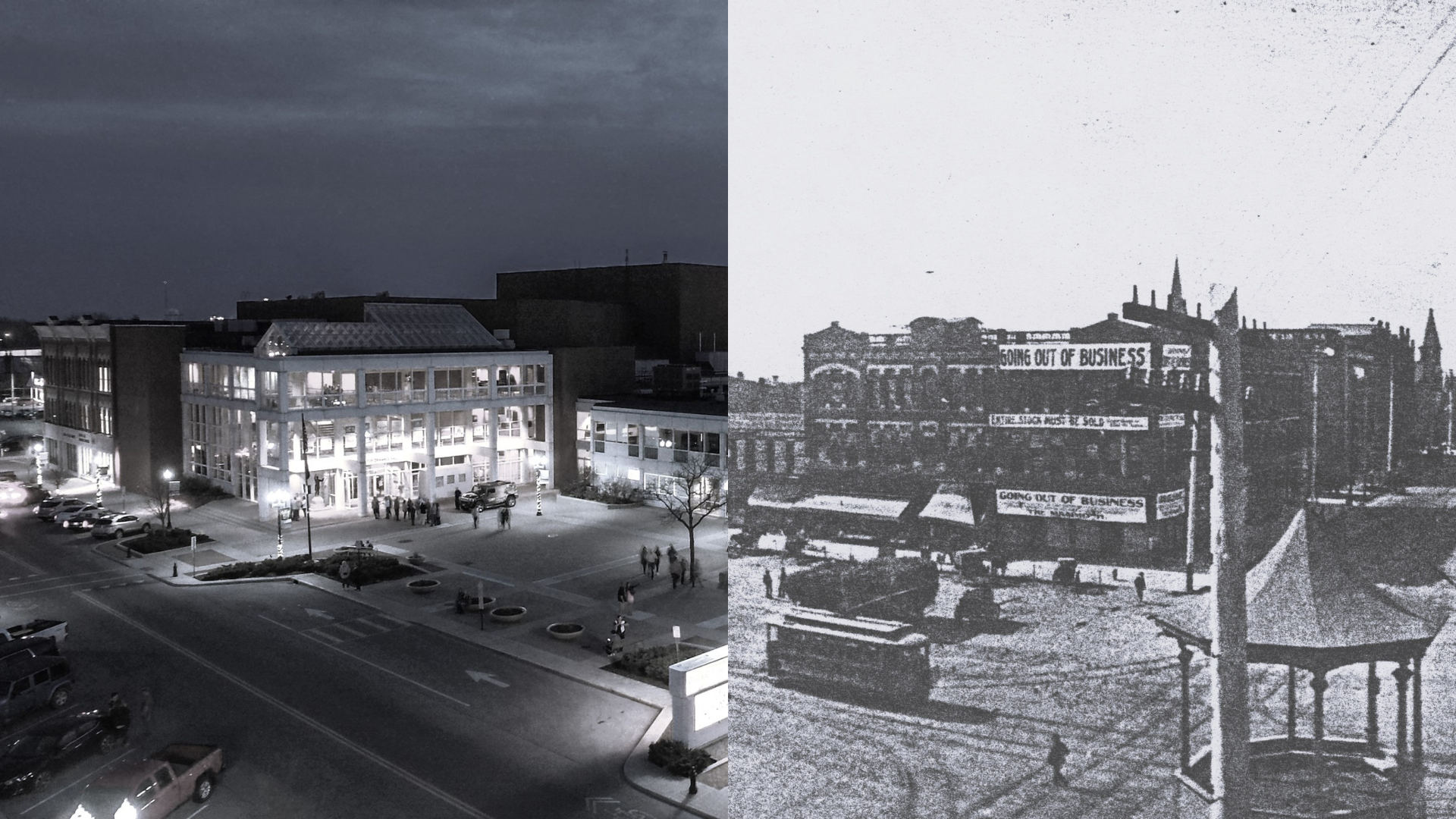
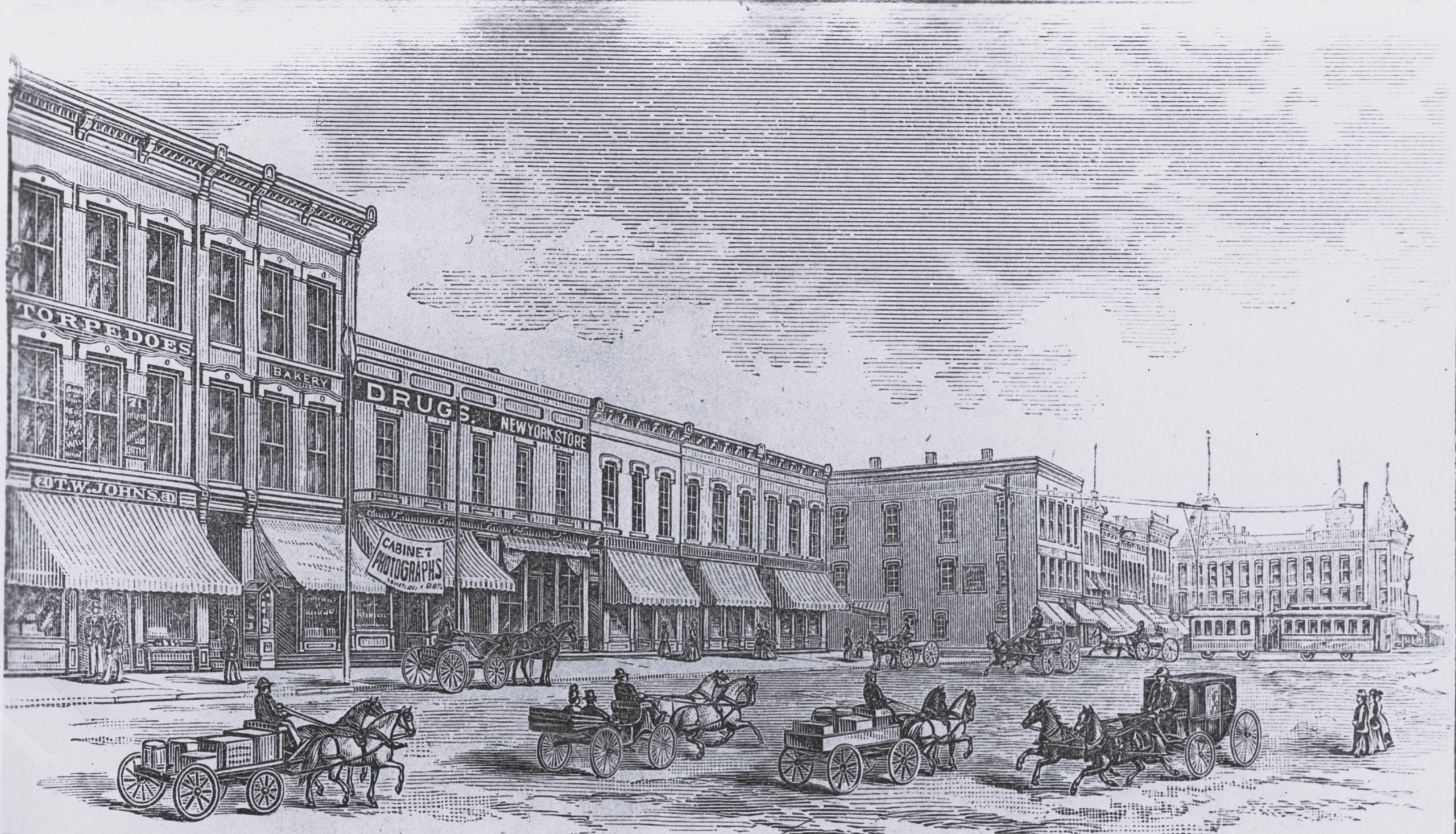
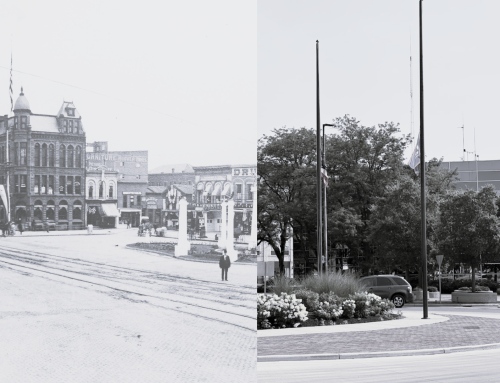
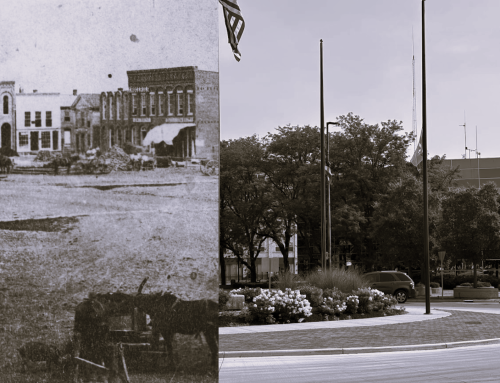
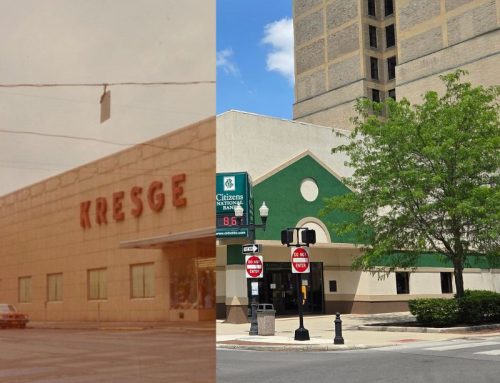
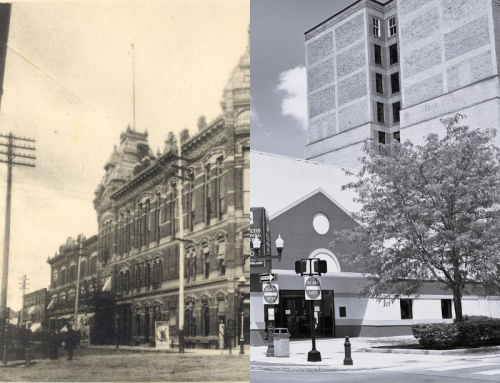
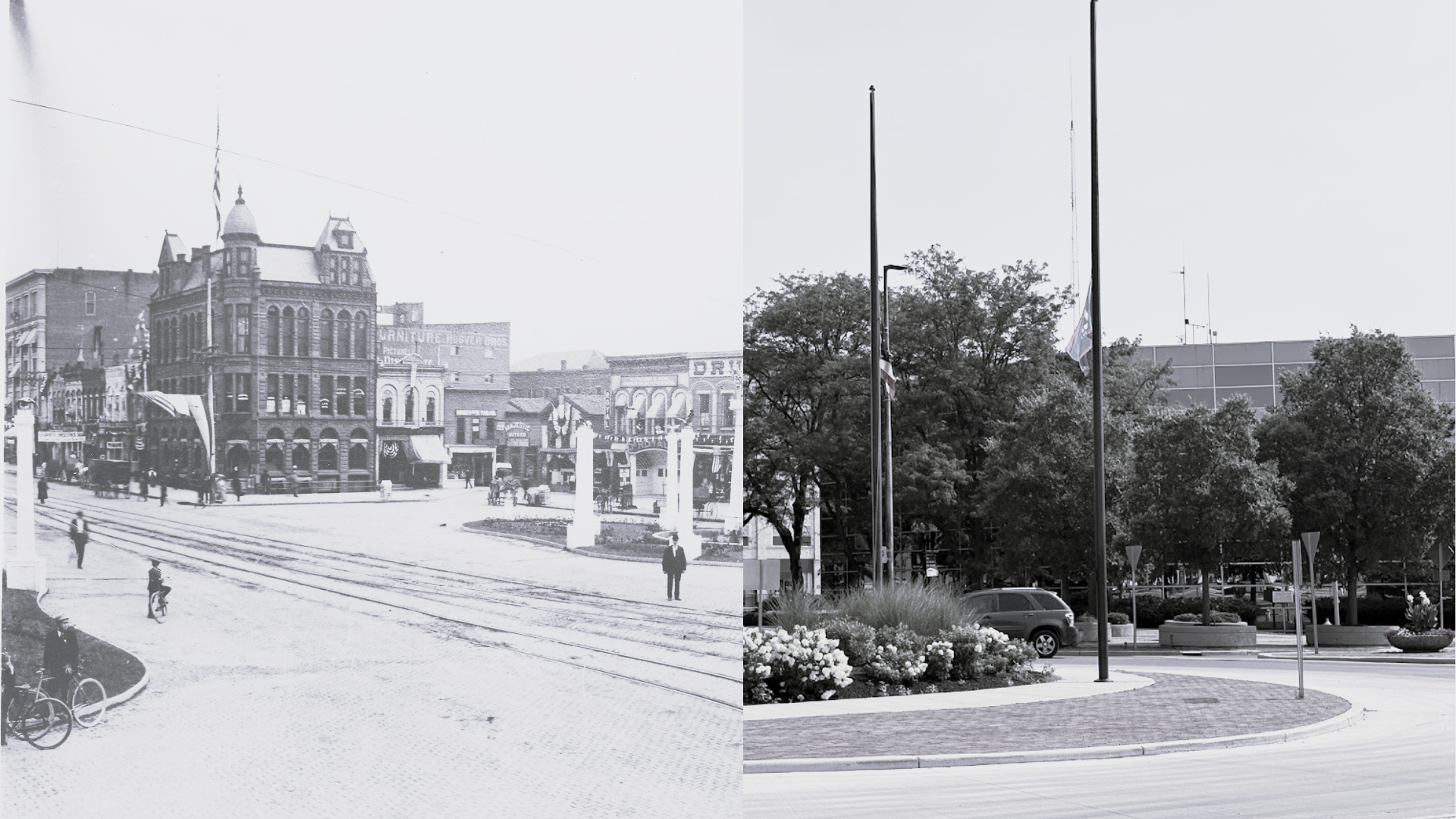
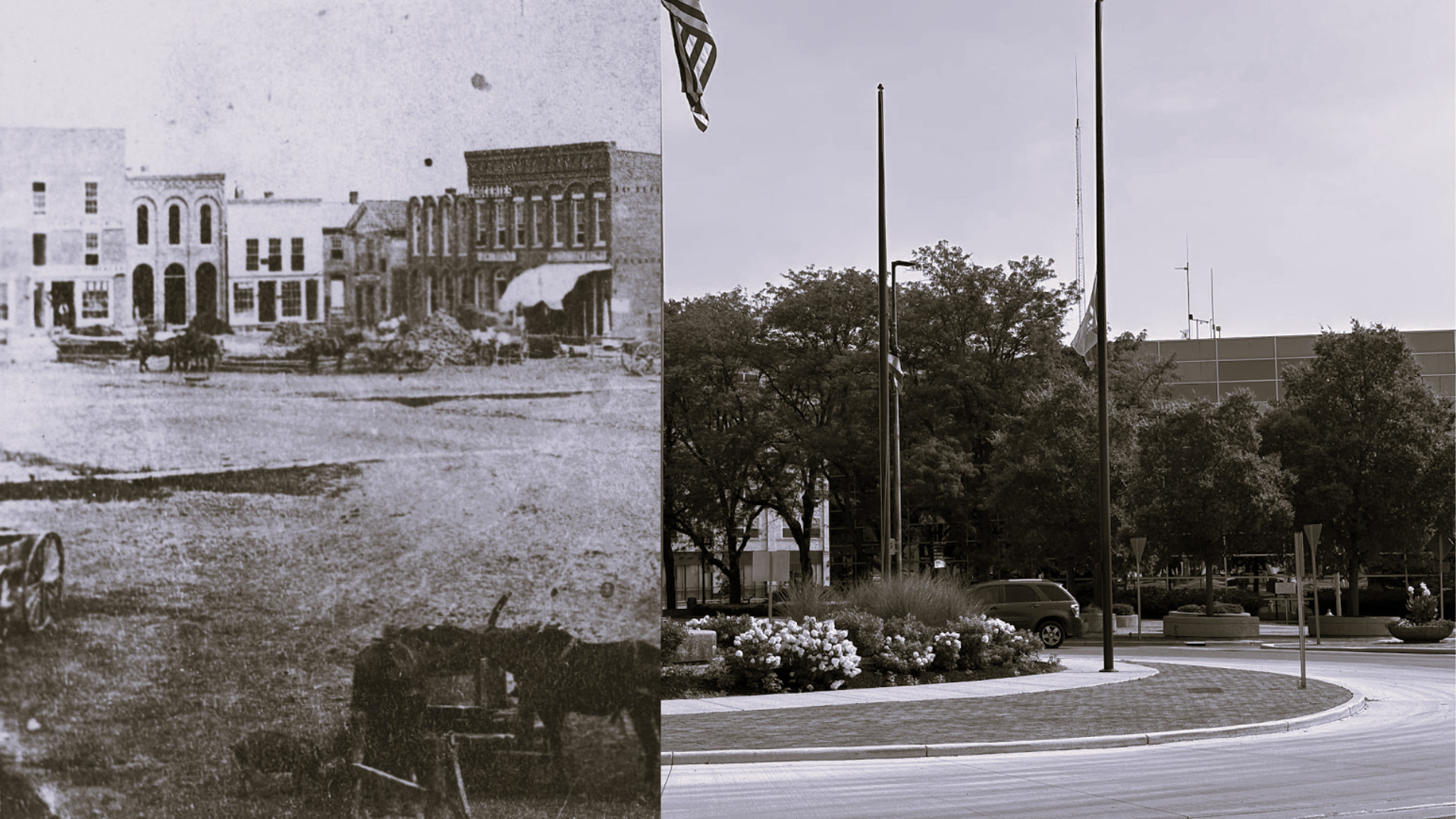
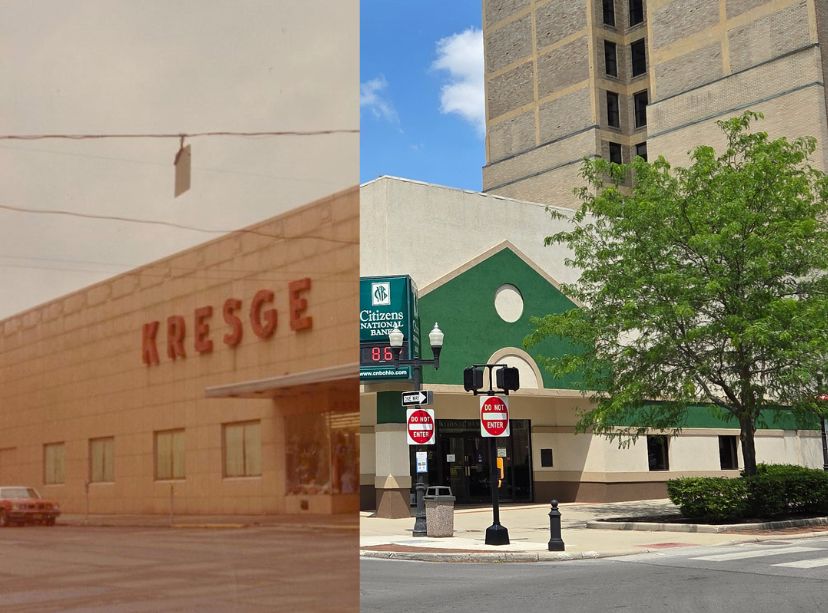
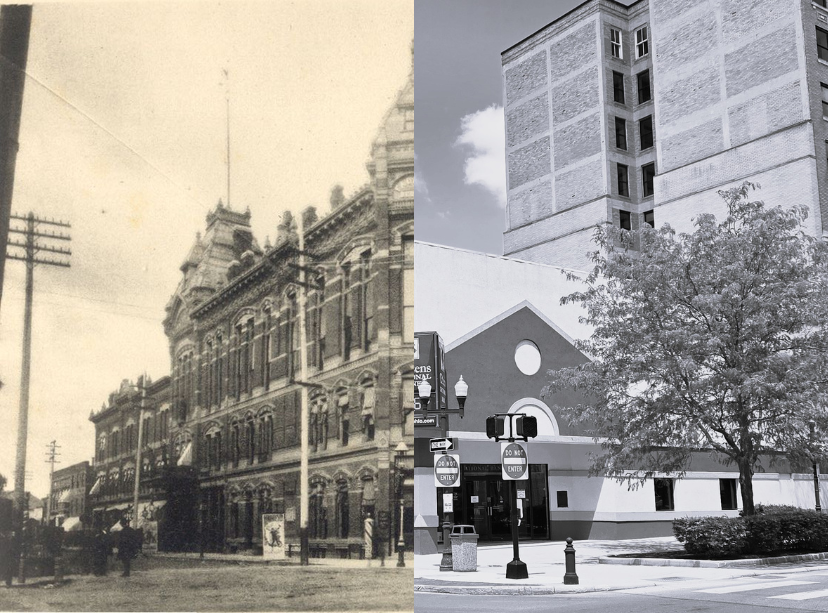
The southwestern quadrant of Lima Public Square once housed some of the most important buildings in this area’s history during the 1800s, and today it hosts the Veterans Memorial Civic Center. For this article, we will focus on the three main city blocks that make up that quadrant: the Badeau, Bowdle, and Cincinnati blocks, during the 1800s. Because of the amount of information, next month’s article will be on the southwestern corner’s history from 1900 to today. The southwest quarter of Lima Public Square housed the courthouse, the town’s first supermarket equivalent, and so many of the businesses that made this area what it is today.
Before venturing further, it is vital to note that before any settlers or pioneers came to the Allen County area, it was the home and trade location of many indigenous tribes, including the Shawnee, Kiikaapoi, Kaskaskia, and Myaami Tribes. These tribes and more were forcefully removed from Allen County and Ohio, and to tell the story of this area without acknowledging this would be an erasure of history. We recognize and honor the past, present, and future lives of Indigenous people in Allen County, as well as the historic tribes that have inhabited the area, and recognize their continued resilience as the original stewards of this land.
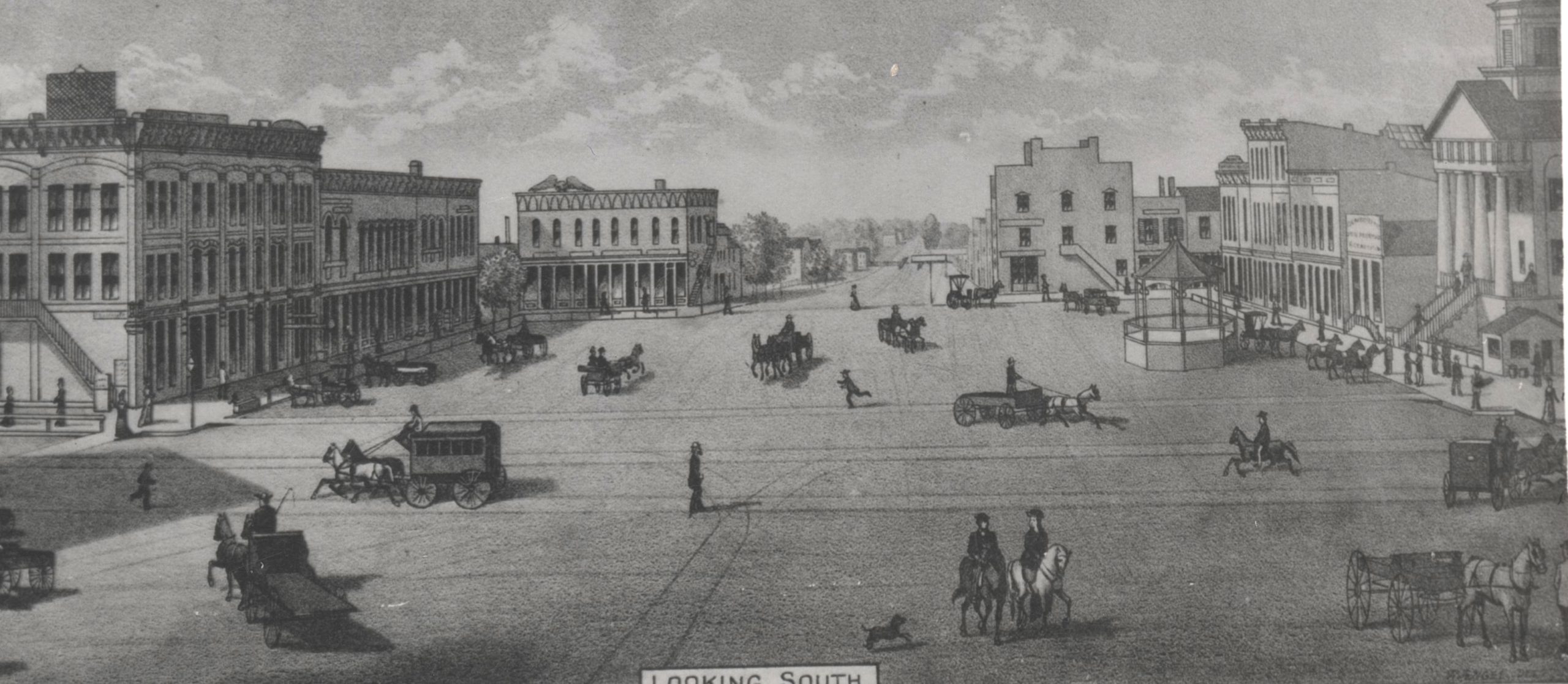
Just like the rest of Allen County, Public Square was built on land that was often called the Black Swamp due to the many marshes and dense forests found in northwestern Ohio. Wooden buildings surrounded the square early on, with dirt roads, sometimes more like a muddy lake, forming the center of Lima. The first building added to the southwest corner, which holds an enduring legacy, was the second Allen County Courthouse. A log courthouse had been built in 1832; it was located on the corner of Main and Spring.[1] Only eight years later, in 1840, the population had grown beyond the log courthouse, and a new one was constructed at the southwest corner of Main and Market streets.[2] A jail was also planned for the basement of the courthouse, with the cost for both being $13,325, or around $500,000 today.[3] Unlike all the other structures around the square, the second courthouse was built of bricks with doric columns gracing its front, a tall bell tower, and steps up to the entrance.[4] The front entrance was built up from the street so the jail could be built slightly underground and have high, grated windows connecting to the street level.[5] When the courthouse was finally finished in December 1842, the whole town threw a party.[6] Women of Lima went to the courthouse early to clean the basement floor to ceiling in preparation.[7] Because they knew the party would last all night, the mothers even set up makeshift beds in the cells to tuck the kids into bed when it got late.[8] Thus, the adults danced the night away enjoying the new courthouse while the children were the first to spend the night in this new Allen County jail.[9] The second courthouse would serve many different purposes during its forty years of use: church, theatre, schoolhouse, along with all of its civic duties.[10]
One of the most famous events of the second courthouse’s history was the case of Andrew Brentlinger. According to some accounts of the time Brentlinger had been taken over by ‘some sort of superstitious mania.’[11] Under this influence in the fall of 1870, Brentlinger killed his wife, dismembered her, and afterwards forced his son and son-in-law to help him bury her in the garden to hide the murder.[12] It is said that he was planning on leaving the country after his villainous act but then came back and was caught.[13] His trial was held at the second courthouse and Brentlinger was convicted for his crimes.[14] He spent four months in the jail, which was then on West North Street, supposedly because Governor Rutherford B. Hayes, later United States President, had interceded for him.[15] However, in the end no evidence could be found in Brentlinger’s favor; thus, he was hung by Sheriff Alex Colbath on April 7, 1871.[16] His hanging, the only legal one to ever happen in Allen County, was a massive event in Lima.[17] The actual act was done behind the walls of the county jail, but his body was put on public display afterwards in the jail yard.[18] According to a young girl at the time, crowds waited eagerly until they were let into the yard and even the most innocent youth from prominent families walked around the coffin multiple times to see Brentlinger’s dead body.[19] As with all prominent criminal cases people were fascinated, and this was undoubtedly the most prominent one of early Allen County history. It was just over ten years later, 1884, when the third courthouse was finished on West North Street right next to the county jail, making the second courthouse obsolete.[20]
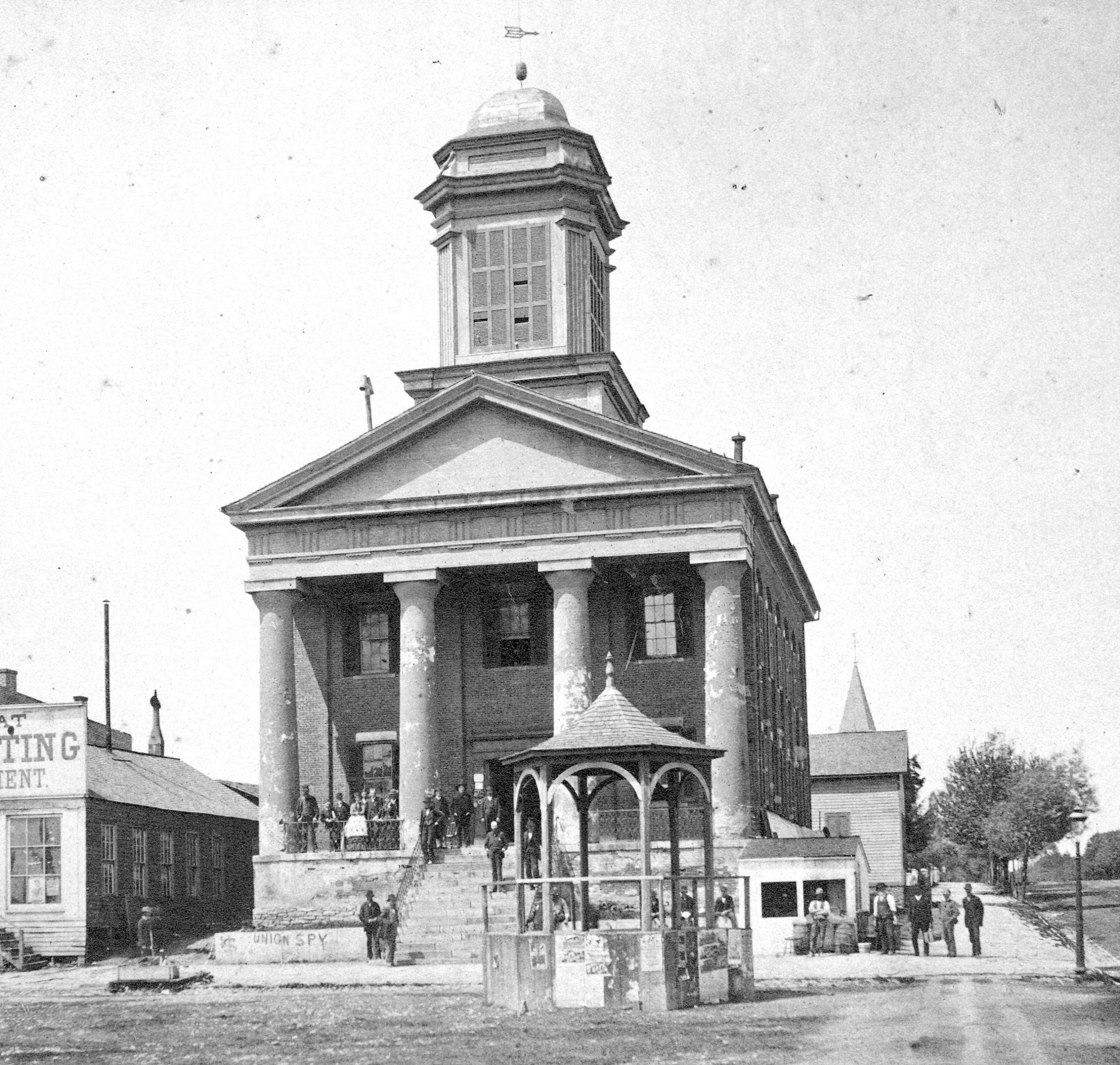
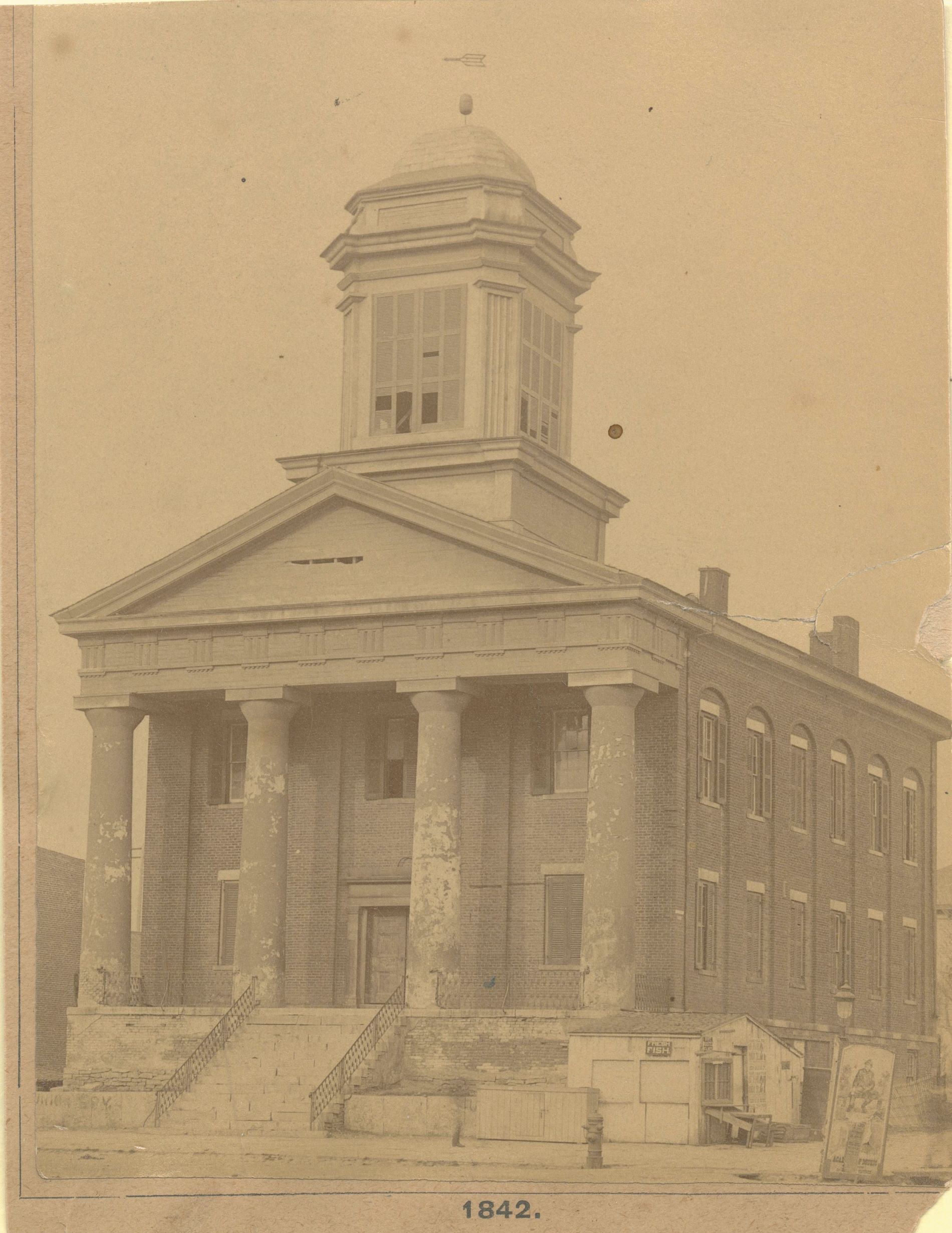
The other main government building that populated the southwest corner of Public Square in the county’s early days was the post office. The post office moved in right next to the second courthouse in 1864, on the first floor of a building.[21] Before that it had been just below the Public Square on the west side of Main Street.[22] It would call Public Square its home until 1883, when the land on the southwest corner of Main and High Streets was bought from Benjamin Faurot for a new post office.[23] That was also the year mail started to be delivered to houses in Lima.[24] Likewise, to facilitate this, the city council passed an ordinance to create a method of officially numbering blocks and addresses.[25] Every block would have 100 numbers and the right side of the street would be even and the left side odd.[26] This is when we finally can follow address numbers for the southwest quadrant. Typically, the southwestern address numbers on Public Square were the small, odd numbers, specifically ranging from 1 – 47.
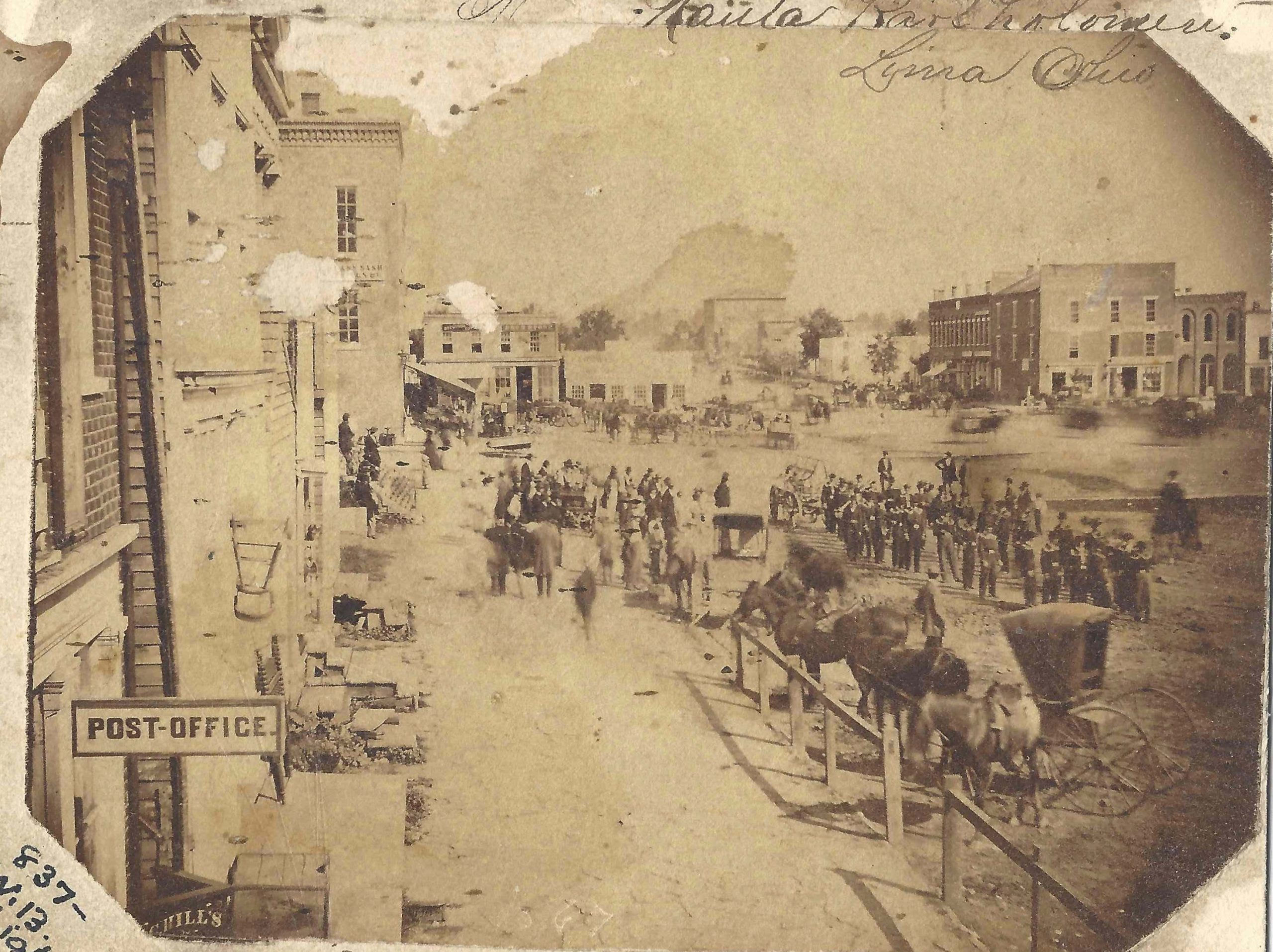
The second courthouse would stand until the spring of 1889, when it was torn down for a new commercial district to be built in its place.[27] The land was first sold to a developer out of Chicago then a group of businessmen out of Cincinnati, who would build a new three-story business block for $23,500.[28] That being equivalent to around $830,000 today.[29] The block was named after the businessmen who built it and is most commonly called the Cincinnati Block. The first store to call the Cincinnati block home was ‘The Mammoth.’ It was a large dry goods store operating much as general stores typically did at the time, just at a larger scale.[30] Within a 60-mile radius, it was the only store of its size and with its variety of products.[31] Likewise, the Cincinnati Block had office space in the upper floors. A few loan companies and dentist offices worked there at this time.[32] Overall, the Cincinnati Block held the first supermarket in the area and helped make the Public Square a bustling business destination in the late 1800s.
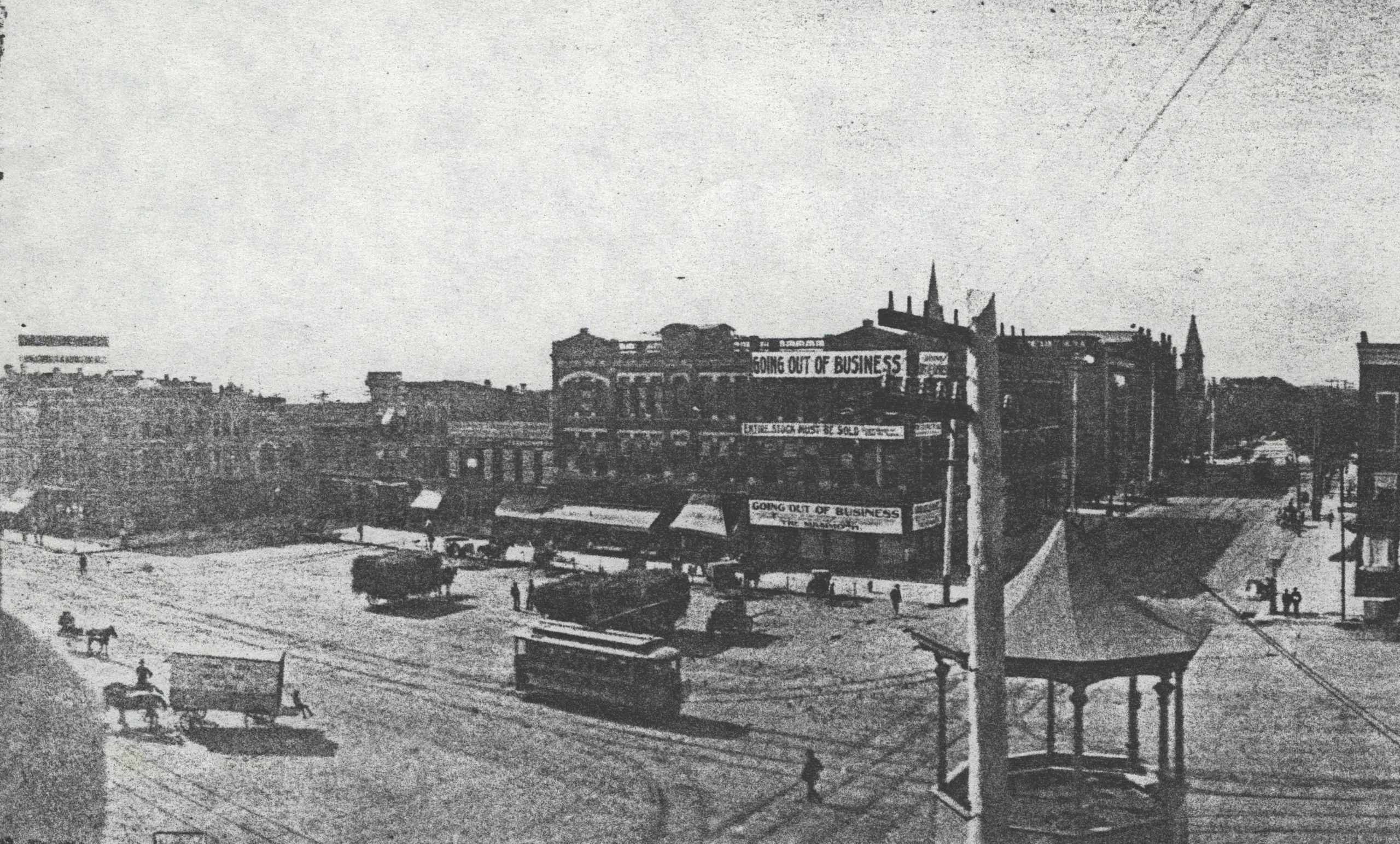
The same year the Cincinnati Block went up, 1889, the Badeau block was built in the southwest corner of Main Street and Public Square.[33] The land had been purchased by Silas Badeau earlier in the 1880s for $2,800, or $89,000 today.[34] At that time, it was a smaller building and a Chinese laundry mat operated out of it.[35] Then after Silas passed, his widow Elsie would receive a building permit, for $6,000 or $211,000 today,[36] and build a three-story brick block in 1889.[37] Many businesses worked out of this new brick block: Cunningham’s Pharmacy owned by Harold Cunningham, architect C. H. Miller, the offices of the Allen County Democrat newspaper, and Matida “Tillie” Badeau’s art studio.[38] Tillie Badeau was the daughter of Silas and Elsie and used some space on the second floor of the Badeau Block for her art studio.[39] Tillie was the most celebrated artist of Allen County at the time.[40] She spent a lot of her time travelling and studying art, but whenever she returned home she would open her studio and teach others to paint.[41] Her students also became known for their talents under her tutelage. The Lima Democrat Times wrote about one of Tillie’s students’ exhibits held in her studio, “It is well worth the visit. The work show[n] is that of pupils of Miss Badeau and will all bear criticism.”[42] There were many art pieces remarked upon in this article, there were landscapes and seascapes as well as works on china which was very popular at the time.[43] Thus, the Badeau Block was a center of arts and business in the late 1800s.
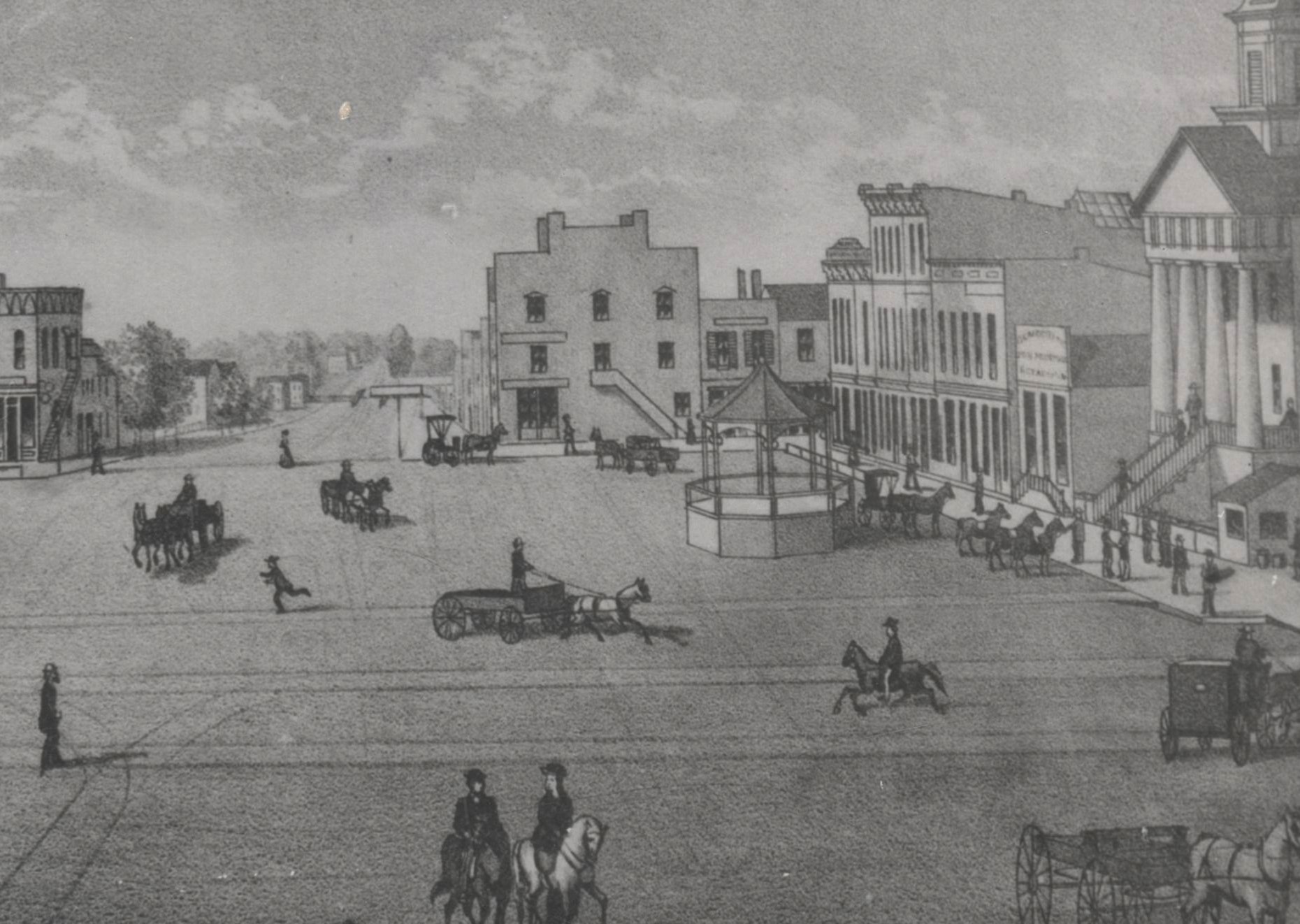
The last important block in the southwestern corner of Public Square was the Bowdle block. The Bowdle family owned the land this block was built on for several decades.[44] First it was their farmland. They later built the building that was then known as the Bowdle Block in 1879.[45] Elisha T. Bowdle constructed the block specifically to be his photography studio, which took up the third level of the building.[46] E. T. Bowdle became well known for his excellent photography and many wealthy citizens of Allen County sat to get their portrait taken by him.[47] After twelve years in business, Bowdle became a traveling minister and his apprentice Harry Hinner took over the photography business in 1891.[48] Hinner was also an excellent photographer and everyone in town knew you would get the best photographs taken at Bowdle Photography. In 1896, Harry would also retire from photography.[49] The studio was then bought by S. L. Hubbard.[50] Just after taking over, Hubbard started selling photography sessions very cheap to be paid up front and scheduled the sessions for a few weeks later.[51] Because of the quality of both Bowdle and Hinner, people of the area were quick to sign up and pay for these sessions.[52] Unfortunately for them, Hubbard was not a photographer—he was a con artist, skipping town with the money and no photographs ever taken.[53] Allen County’s trust was broken, so when another group, Duffield and Hughes, tried to set up a photography studio in the Bowdle Block they eventually went under because they lacked business.[54] Other photography studios would make it in Lima, but none tried to do so out of the Bowdle Block.
Another business that thrived out of the Bowdle Block was the Lima Tea Company, opening sometime in the late 1800s before 1889.[55] The business obviously sold teas but also other small miscellaneous items like you would get at a small convenience store.[56] In 1892, Joseph R. Rickoff became the first notable owner. He had been a travelling tea salesman for around fifteen years and quit that job and came to Lima in May of 1868.[57] Under his ownership, Lima Tea Co. flourished. The following year, 1893, they added freshly roasted coffee to their sales for $.25 per pound, or $9 today.[58] Likewise, in 1895, they started doing gifts with purchases of coffee.[59] The advertisement read about these gifts with purchases, “Gold watches, parlor lamps, glassware, handsomely decorated dinner sets, elegantly framed pictures, jardiniers[60], the Lima Tea Co. is the place to get these things and not cost a cent.”[61] Pretty great gifts for purchases even to today’s standards. These could be given to the shopper either when the goods were purchased or they would get a voucher to pick up the gift with purchase later.[62] Lima Tea Co. would call the Bowdle Block their home until 1906, when plans for a grocery store to be built there caused them to relocate to 218 S. Main Street.[63] We will follow what went into the Bowdle Block next in the March newsletter article.
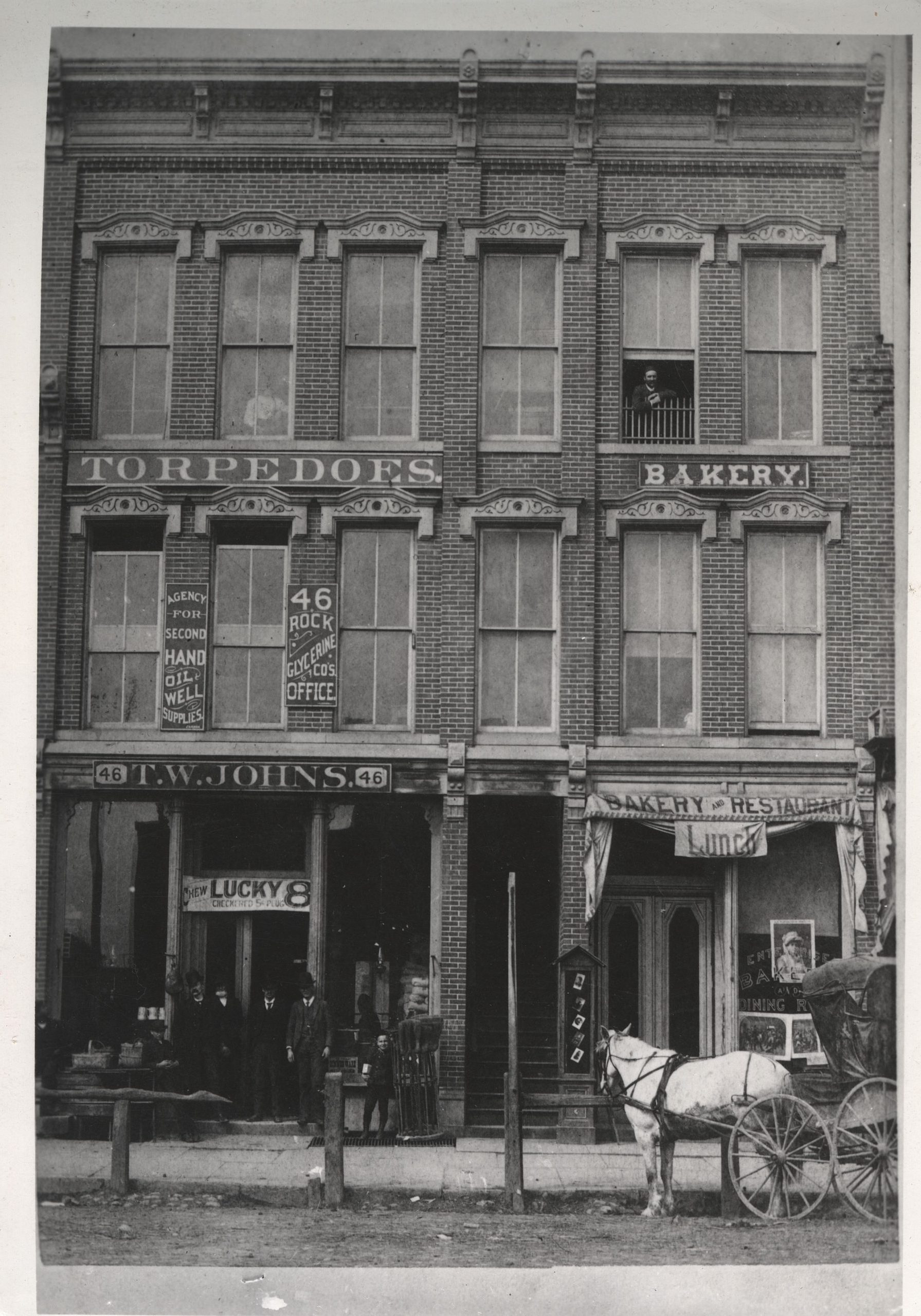
The southwestern quarter of Lima Public Square was a bustling and integral part of early life in Allen County. From holding the second courthouse and jail all the way to all the stores of the late 1800s, this corner made its mark on this area’s history. Next month, we will continue the story up to the present day.
[1] Greg Hoerston, “Reminisce: Lima Outgrows Log Courthouse,” Lima News, August 26, 2025, accessed October 23, 2025, https://www.limaohio.com/top-stories/2025/08/26/reminisce-lima-outgrows-log-courthouse/.
[2] Ibid.
[3] Ezekiel Owen, “More Trip Through Time,” Allen County Reporter, Vol. LXVI, 2012, No. 2., 66, and https://www.officialdata.org/us/inflation/1840?amount=13325.
[4] William Rusler, A Standard History of Allen County, Ohio, The American Historical Society: Chicago and New York, 1921, 247.
[5] Anna B. Selfridge, “West Market: the South Side,” Allen County Reporter, Vol. LXIV, 2010, No. 2, 46.
[6] William Rusler, A Standard History of Allen County, Ohio, The American Historical Society: Chicago and New York, 1921, 248.
[7] Ibid.
[8] Ibid.
[9] Ibid.
[10] Ezekiel Owen, “More Trip Through Time,” Allen County Reporter, Vol. LXVI, 2012, No. 2., 66.
[11] Greg Hoerston, “Reminisce: Lima Outgrows Log Courthouse,” Lima News, August 26, 2025, accessed October 23, 2025, https://www.limaohio.com/top-stories/2025/08/26/reminisce-lima-outgrows-log-courthouse/.
[12] “Andrew Brentlinger,” The Lima News, April 9, 1909, accessed November 5, 2025, https://www.newspapers.com/article/the-lima-news-andrew-brentlinger/14351283/.
[13] Ibid.
[14] Greg Hoerston, “Reminisce: Lima Outgrows Log Courthouse,” Lima News, August 26, 2025, accessed October 23, 2025, https://www.limaohio.com/top-stories/2025/08/26/reminisce-lima-outgrows-log-courthouse/.
[15] “Andrew Brentlinger,” The Lima News, April 9, 1909, accessed November 5, 2025, https://www.newspapers.com/article/the-lima-news-andrew-brentlinger/14351283/.
[16] “Andrew Brentlinger,” The Lima News, April 9, 1909, accessed November 5, 2025, https://www.newspapers.com/article/the-lima-news-andrew-brentlinger/14351283/, and Greg Hoerston, “Reminisce: Lima Outgrows Log Courthouse,” Lima News, August 26, 2025, accessed October 23, 2025, https://www.limaohio.com/top-stories/2025/08/26/reminisce-lima-outgrows-log-courthouse/.
[17] Greg Hoersten, “Reminisce: Butler’s ‘Rare Mental Attainments,’” Lima News, March 10, 2021, accessed November 5, 2025, https://www.limaohio.com/archive/2021/03/10/reminisce-butlers-rare-mental-attainments/.
[18] Ibid.
[19] Ibid.
[20] Greg Hoerston, “Reminisce: Lima Outgrows Log Courthouse,” Lima News, August 26, 2025, accessed October 23, 2025, https://www.limaohio.com/top-stories/2025/08/26/reminisce-lima-outgrows-log-courthouse/.
[21] The 1976 History of Allen County, Ohio, ed. John R. Carnes, Evansville, Indiana: Unigraphic Inc., 1976, 25.
[22] Owens Reporter 35.
[23] The 1976 History of Allen County, Ohio, ed. John R. Carnes, Evansville, Indiana: Unigraphic Inc., 1976, 25.
[24] Kim Kincaid, “Allen County Post Office Kept Us in Touch,” Lima News, January 22, 1992, at the Allen County Archives.
[25] Ibid.
[26] Ibid.
[27] Greg Hoerston, “Reminisce: Lima Outgrows Log Courthouse,” Lima News, August 26, 2025, accessed October 23, 2025, https://www.limaohio.com/top-stories/2025/08/26/reminisce-lima-outgrows-log-courthouse/.
[28] Anna B. Selfridge, “West Market: the South Side,” Allen County Reporter, Vol. LXIV, 2010, No. 2, 47.
[29] https://www.in2013dollars.com/us/inflation/1889?amount=23500, accessed November 18, 2025.
[30] Anna B. Selfridge, “West Market: the South Side,” Allen County Reporter, Vol. LXIV, 2010, No. 2, 47.
[31] Ibid.
[32] Ibid.
[33] Dwane Grace, “The Badeau Family of Allen County,” Allen County Reporter, Vol. LXI, 2006, No. 1, 22.
[34] https://www.in2013dollars.com/us/inflation/1880?amount=2800, accessed November 19, 2025, and Dwane Grace, “The Badeau Family of Allen County,” Allen County Reporter, Vol. LXI, 2006, No. 1, 22.
[35] Greg Hoersten, “Badeau Family Roots,” Lima News, June 13, 2018, in Reminisce files at the Allen County Archives.
[36] https://www.in2013dollars.com/us/inflation/1889?amount=6000, accessed November 19, 2025.
[37] Dwane Grace, “The Badeau Family of Allen County,” Allen County Reporter, Vol. LXI, 2006, No. 1, 22, and Greg Hoersten, “Badeau Family Roots,” Lima News, June 13, 2018, in Reminisce files at the Allen County Archives.
[38] Greg Hoersten, “Badeau Family Roots,” Lima News, June 13, 2018, in Reminisce files at the Allen County Archives, and Greg Hoerston, “Rise and Fall of Dime Savings Bank,” Lima, October 27, 2021, in the Reminisce files at the Allen County Archives.
[39] Ibid.
[40] Greg Hoersten, “Badeau Family Roots,” Lima News, June 13, 2018, in Reminisce files at the Allen County Archives.
[41] Greg Hoersten, “Reminisce: Tillie Badeau Advertised as Lima’s Most Famous Artist,” Lima News, June 24, 2025, accessed November 3, 2025, https://www.limaohio.com/top-stories/2025/06/24/reminisce-tillie-badeau-advertised-as-limas-most-famous-artist/.
[42] “Art Exhibition,” Lima Democrat Times, February 27, 1890, in Allen County Archives.
[43] Ibid.
[44] “A Portrait of a Snoozer the Pug,” accessed November 20, 2025, https://thepethistorian.com/2017/07/11/a-portrait-of-snoozer-the-pug/.
[45] Andrew Ewry, “Bowdle Block Photography,” Lima News, January 17, 2018, in Reminisce Files at the Allen County Archives.
[46] Ibid.
[47] Ibid.
[48] Ibid.
[49] Ibid.
[50] Ibid.
[51] Ibid.
[52] Ibid.
[53] Ibid.
[54] Ibid.
[55] Adrienne McGee, “Lima Tea Co.: Supplying Caffeine to All,” Lima News, December 30, 2009, in Reminisce files at the Allen County Archives.
[56] Ibid.
[57] Ibid.
[58] Adrienne McGee, “Lima Tea Co.: Supplying Caffeine to All,” Lima News, December 30, 2009, in Reminisce files at the Allen County Archives. and https://www.in2013dollars.com/us/inflation/1893?amount=0.25, accessed November 20, 2025.
[59] Adrienne McGee, “Lima Tea Co.: Supplying Caffeine to All,” Lima News, December 30, 2009, in Reminisce files at the Allen County Archives.
[60] Jardinieres: typically, a flowerpot or urn to plant or display flowers in.
[61] Adrienne McGee, “Lima Tea Co.: Supplying Caffeine to All,” Lima News, December 30, 2009, in Reminisce files at the Allen County Archives.
[62] Ibid.
[63] Ibid.
“[Aerial View of Lima Civic Center],” accessed January 27, 2026, https://static.wixstatic.com/media/7dbca1_045125d7d53442ebb6ecafbc420b9524~mv2_d_2880_1626_s_2.jpg/v1/fill/w_1901,h_929,al_c,q_85,usm_0.66_1.00_0.01,enc_avif,quality_auto/7dbca1_045125d7d53442ebb6ecafbc420b9524~mv2_d_2880_1626_s_2.jpg.
All other images from the Allen County Archives.












Leave A Comment