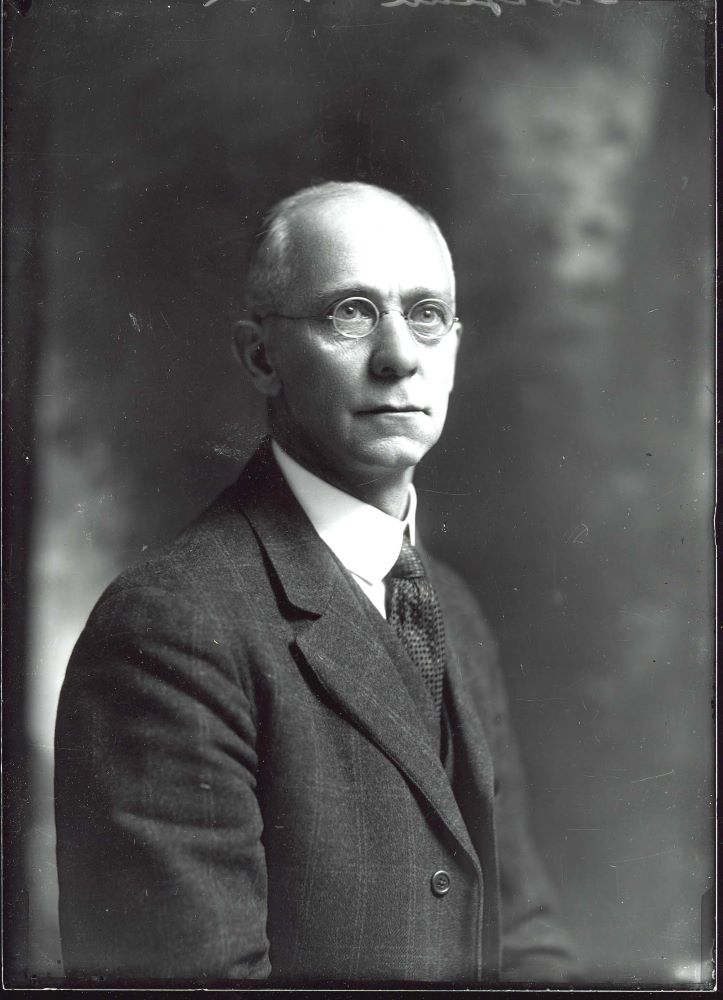
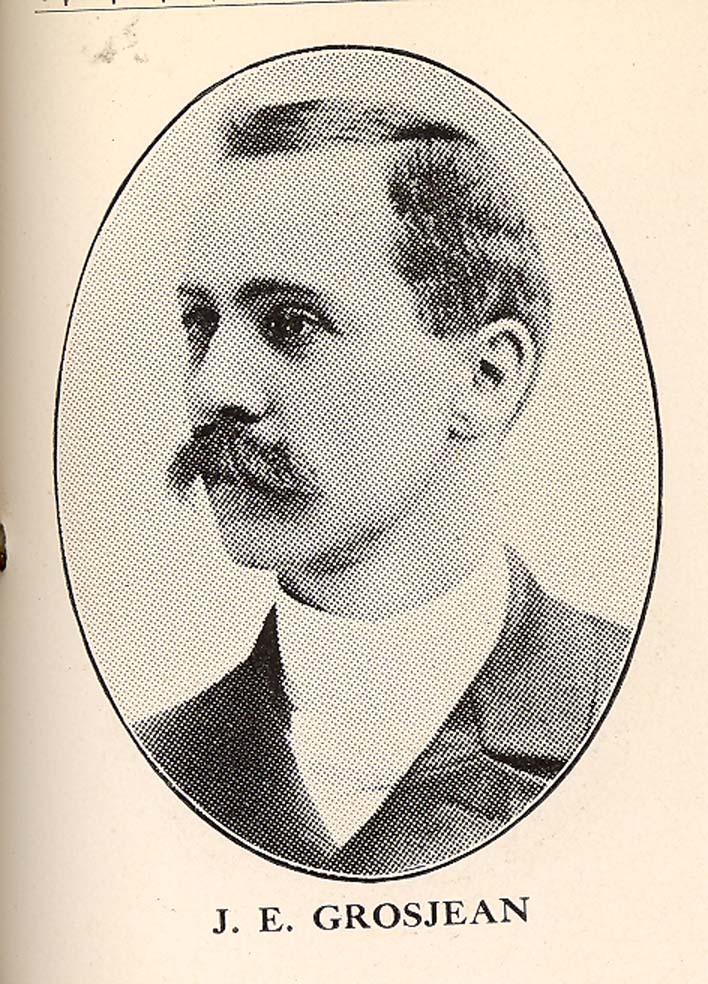
“By all accounts, Grosjean was a polymath, responsible for the impressive reliquary that is this Lima museum [Allen County Museum]. He was an undertaker, a shoe salesman, an inventor, a historian and full time innovator.” [1]
Grosjean was a renaissance man connected to many industries. Last month’s article, read here if you missed it, covered his early years, his first two careers, and the creation of his “spectacular machines.” This article will focus on two of his main inventions, the Humane Horseshoe and Gro-cord rubber soles. Likewise, we will note his other patents. With the Gro-cord rubber soles, Grosjean became a factory manufacturer, and we will touch on that era as well. Finally, we will cover the end of his life and his relationship with the Allen County Historical Society. Overall, J. E. Grosjean was an innovator whose creativity brought both wonder and reliability.
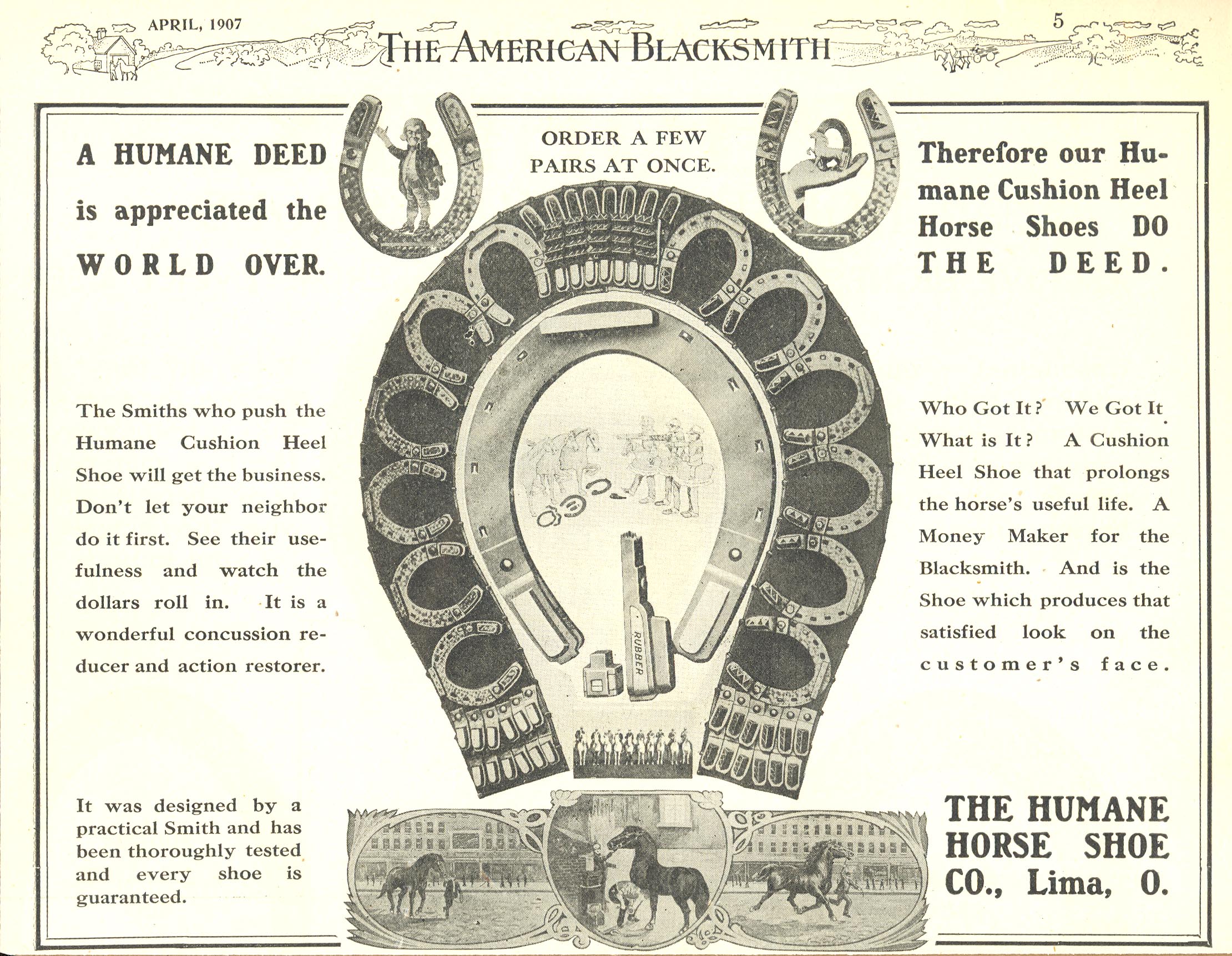
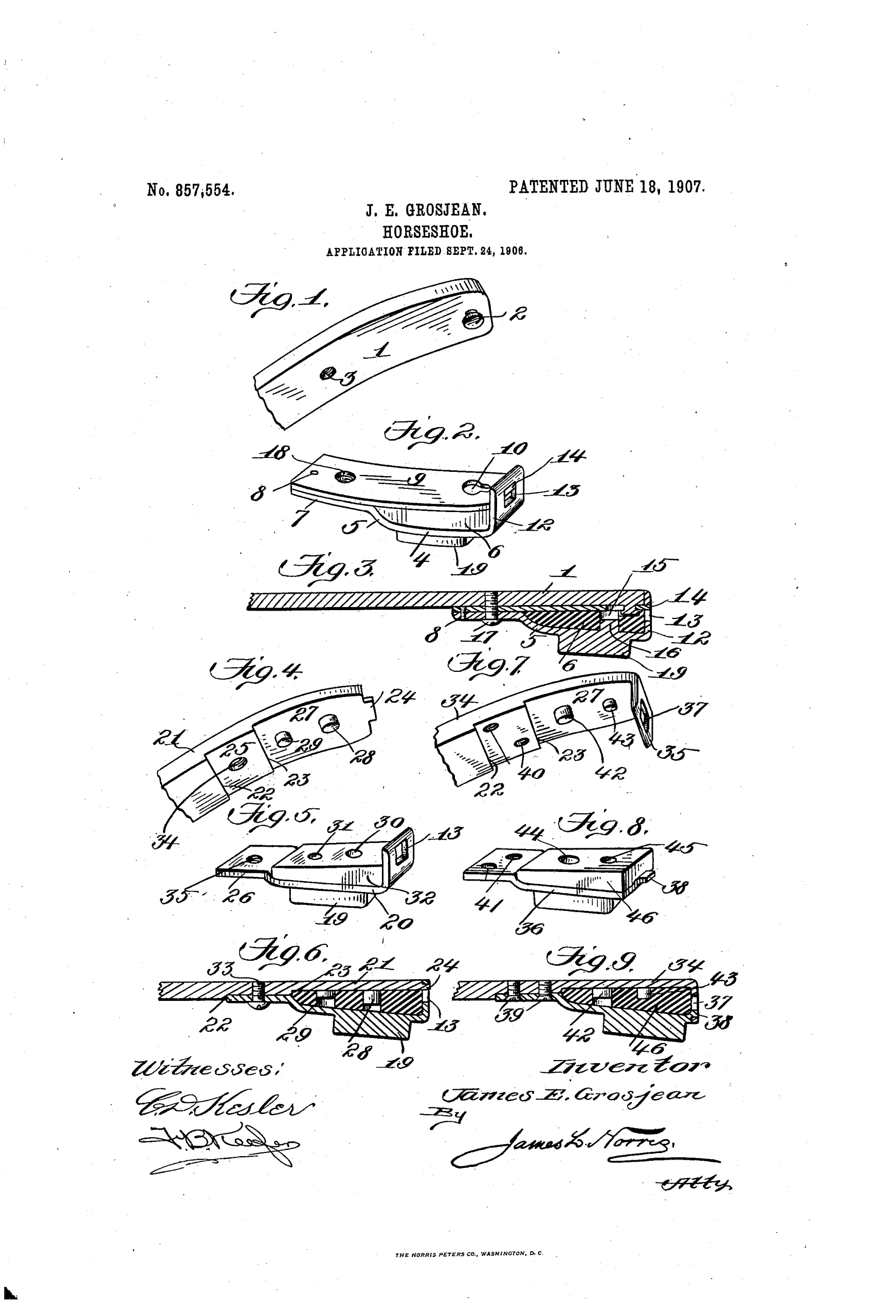
Around 1905, Grosjean started another company, this one was with Frank B. Gardner: the Humane Horseshoe Company.[2] Gardner was the original inventor and patent holder of the humane horseshoe.[3] It was a horseshoe with rubber bonded to the shoe to cushion the horse’s hooves from all terrain.[4] The factory for Humane Horseshoe Company was built on the east side of Lima near the D.T.&I. Railroad.[5] There they not only created the rubber soled horseshoes, but also did drop forging.[6] Together Grosjean and Gardner would create four more horseshoe patents, all iterating from Gardner’s original designs.[7] One of the main things they tweaked was how the rubber sole could be replaced easily without compromising the rest of the horseshoe but not making it too easy to remove as not to cause injury to the horse. As a promotion for Humane Horseshoe, Grosjean sent President Theodore Roosevelt some of their horseshoes for the president’s favorite horse.[8] It was unclear whether President Roosevelt ever used the horseshoes, or if he did use them, what his thoughts were. Unfortunately, Humane Horseshoe Company did not do well. Only a few years later, in 1910, they went out of business.[9] Often, the end of the business was blamed on the rise of the automobile industry; however, the dates seem a little off.[10] If it had been five years later when the Model-T was thoroughly crushing the market, maybe that would be the case. However, in 1905-1910, automobiles were an expensive and untrustworthy luxury, most people still used horses.[11] No matter what caused it, the Humane Horseshoe Company went out of business in 1910.[12] So, a group, including Grosjean, purchased the factory; it was turned into Lima Drop Forging Company.[13] Grosjean was made the director of the new company, and in the end it turned out to be not too much of a loss for him. Not to mention, he became very familiar with the United States patenting process.
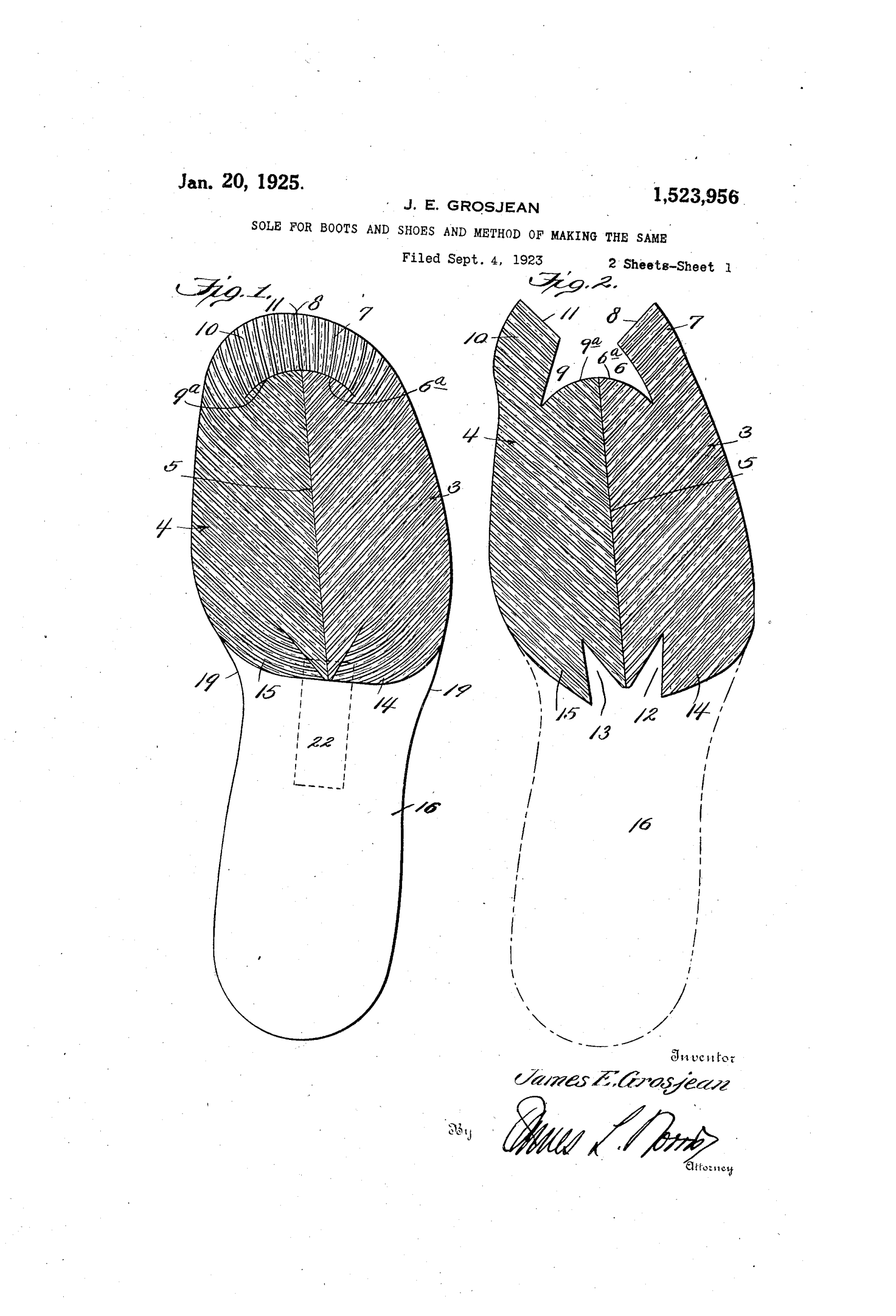
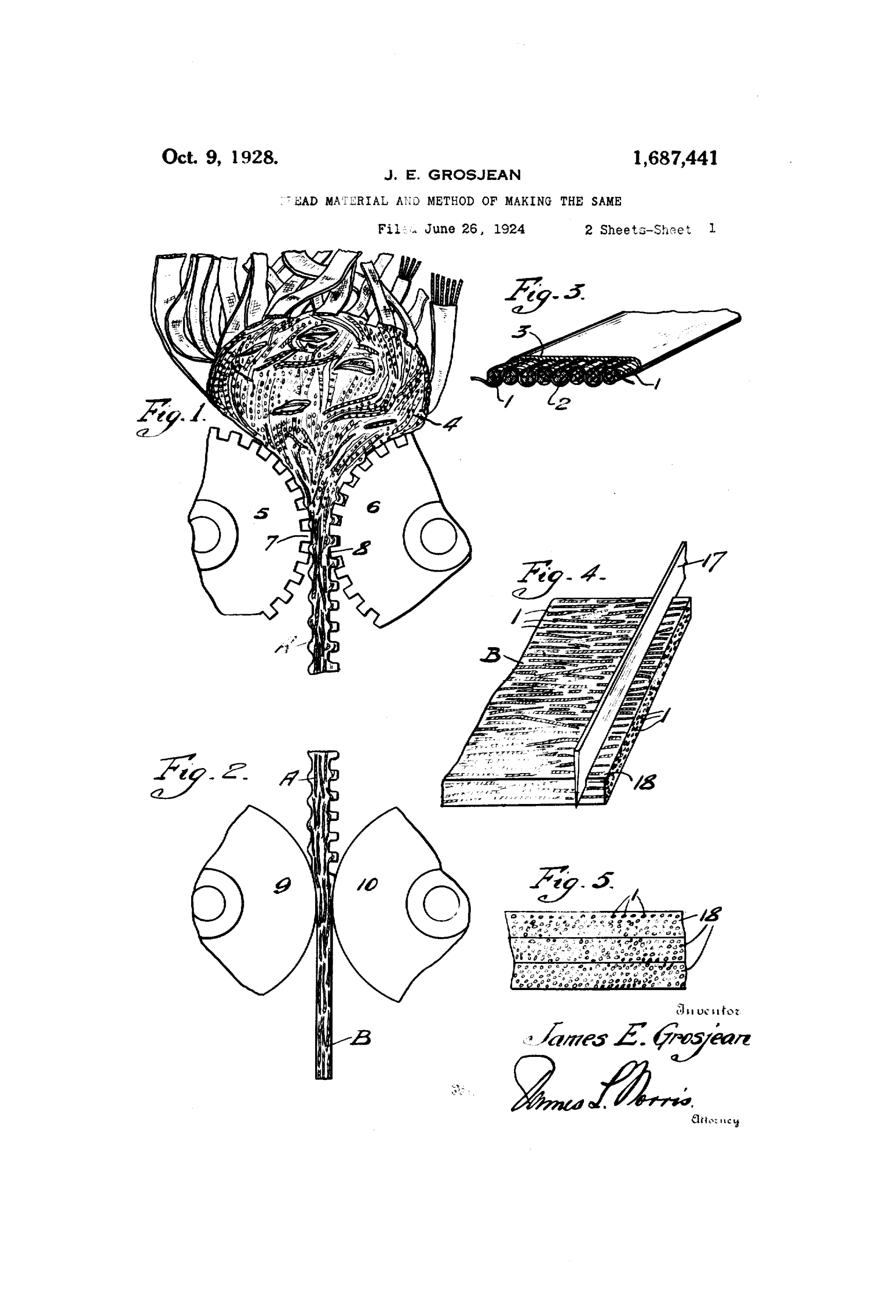
A few years after Humane Horseshoe Company went under, and while he still owned the Grosjean & Hall shoe store, Grosjean came across another rubber innovation he wanted to patent. According to the story, Grosjean saw someone repair a broken shoe sole with a rubber tire and realized that rubber soles would work far better than the typical leather of the time.[14] In addition, leather shoes had other problems from how uncomfortable they were too often being very slippery in bad weather.[15] He began experimenting with rubber soles around 1917.[16] He would test them himself, but also in 1918, he had shoe manufacturers test them.[17] The same year, Grosjean submitted his first few rubber sole patents.[18] The process he created mixed rubber and fabric for the sole, finally encasing that with a rubber edge, and then all of it was vulcanized together.[19] This process was later named Gro-Cord after Grosjean. Claims for the process at that time were that they would wear out just as fast as the upper part of the shoe; thus meaning, not very fast.[20] From then until 1928, Grosjean received nine patents where he perfected the Gro-Cord process.[21] His main tweaks throughout the patents were due to keeping costs low, mostly by using old tires in the process, and making them as wear-resistant and anti-slip as possible.[22] Likewise, he held three patents for a heel design for boots, again with a rubber mixture.[23] Right before Grosjean passed away, he sued Panther-Panco Rubber Company for infringing upon his patent.[24] Unfortunately, he would die before the case was brought to court. In the end, they could not prove it was infringement.[25] Grosjean’s innovative mind did not stop with the shoe sole when it came to rubber manufacturing, but we will talk about that after we discuss Lima Cord Sole & Heel Company.
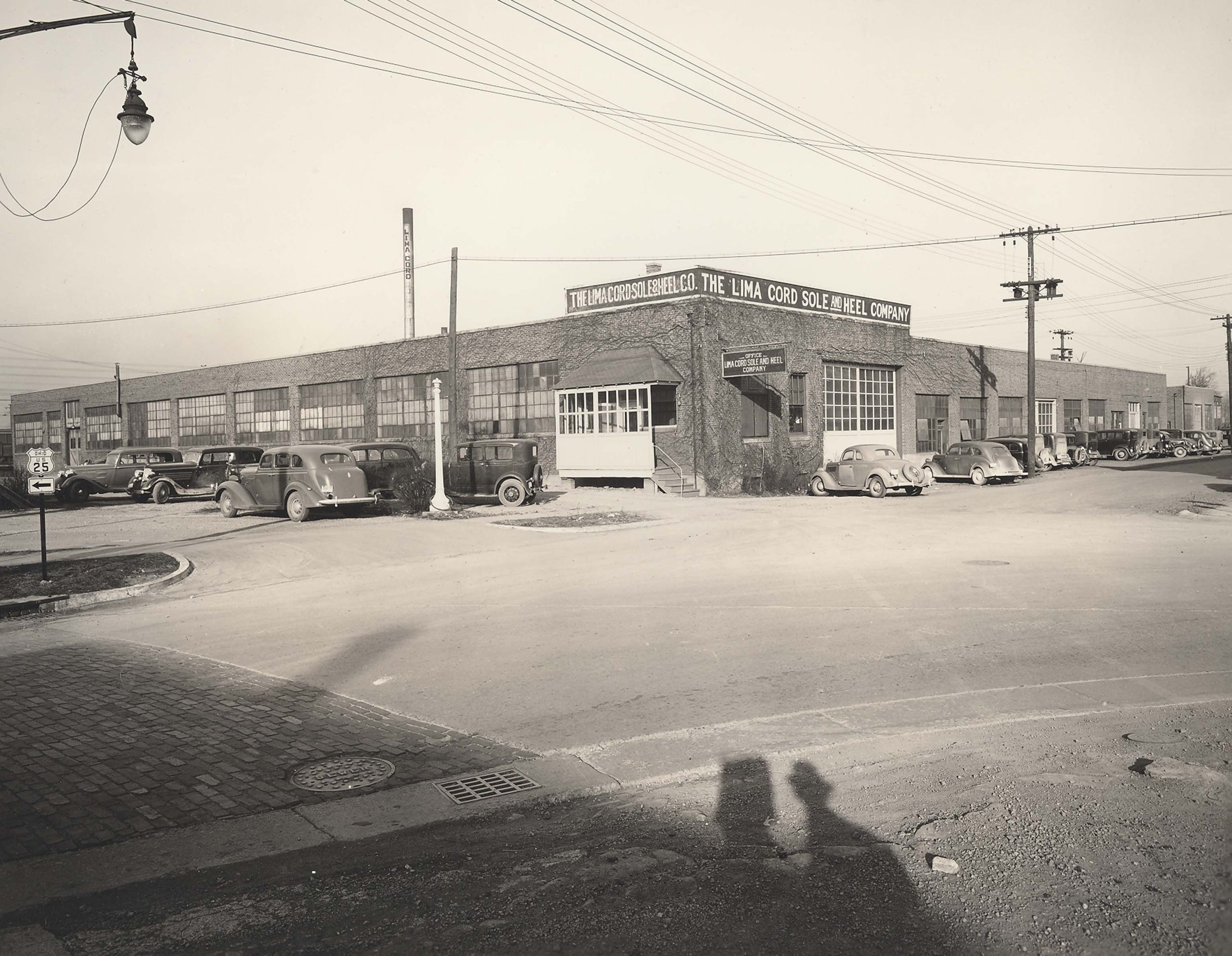
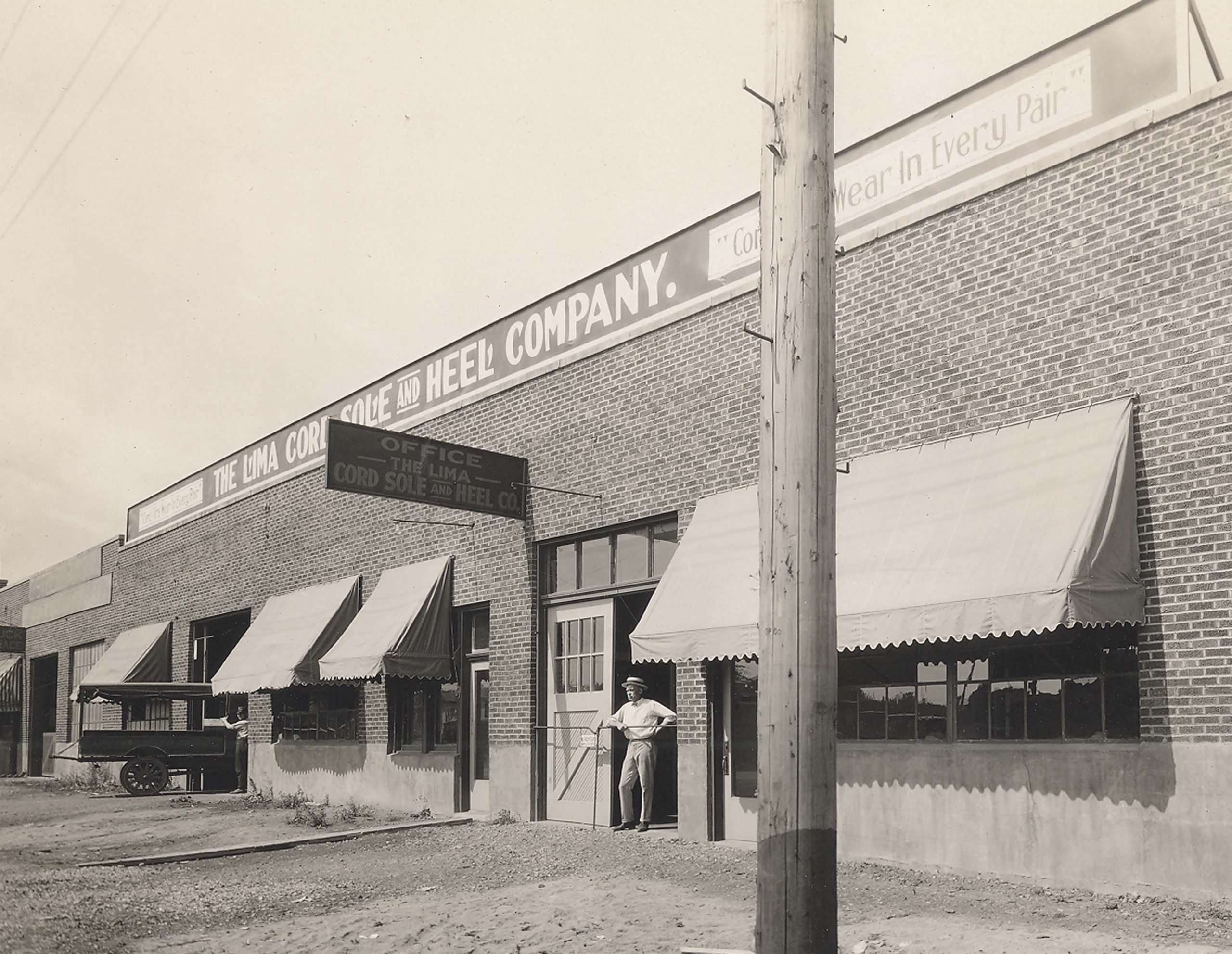
After inventing the Gro-Cord process, Grosjean decided he wanted to get into the manufacturing business himself. In January 1920, Grosjean sold his shoe store, after sixteen years of owning it.[26] Right afterwards, he began building a factory to start producing Gro-Cord rubber-soled shoes.[27] The factory was built at 447 N. Elizabeth Street, one block north of Elizabeth Street BMV today.[28] Before the factory was even built, orders were pouring in for the product. Grosjean remarked to the newspaper that they had enough orders for one year of production.[29] Grosjean’s heel patents were also to be manufactured there.[30] The company specifically manufactured these products to sell to shoe companies, but they did not make the entire shoe.[31] Around this time, Grosjean came up with another ingenious marketing idea—pay a man to walk from coast to coast in some Gro-Cord shoes to show how wearable and long lasting the product was.[32] The company consistently did well for the next few years, so in 1924 they expanded to another factory.[33] This one was located at 817 N. Jackson Street, right on the corner of Flanders Ave and N. Jackson.[34] They would outgrow that factory as well in 1937, after reportedly having been manufacturing for 24-hour shifts a day for most of 1936.[35] They could not keep up with the demands and needed to expand. Likewise, in 1937, the company was finally on the Chicago Stock Exchange, for $1,000,000.[36] This meant it was a publicly traded company, allowing people to buy and sell stocks. The product was well beloved by the public, leading to high demand. The National Safety Council also endorsed it as the standard protection against slipping accidents.[37] In 1937, Grosjean would step down from being the company president, as he was getting on in years.[38] His son-in-law, Frank Maire, who had been a part of the business from the start stepped into the role of president.[39] The company flourished for many years even after Grosjean was no longer involved.
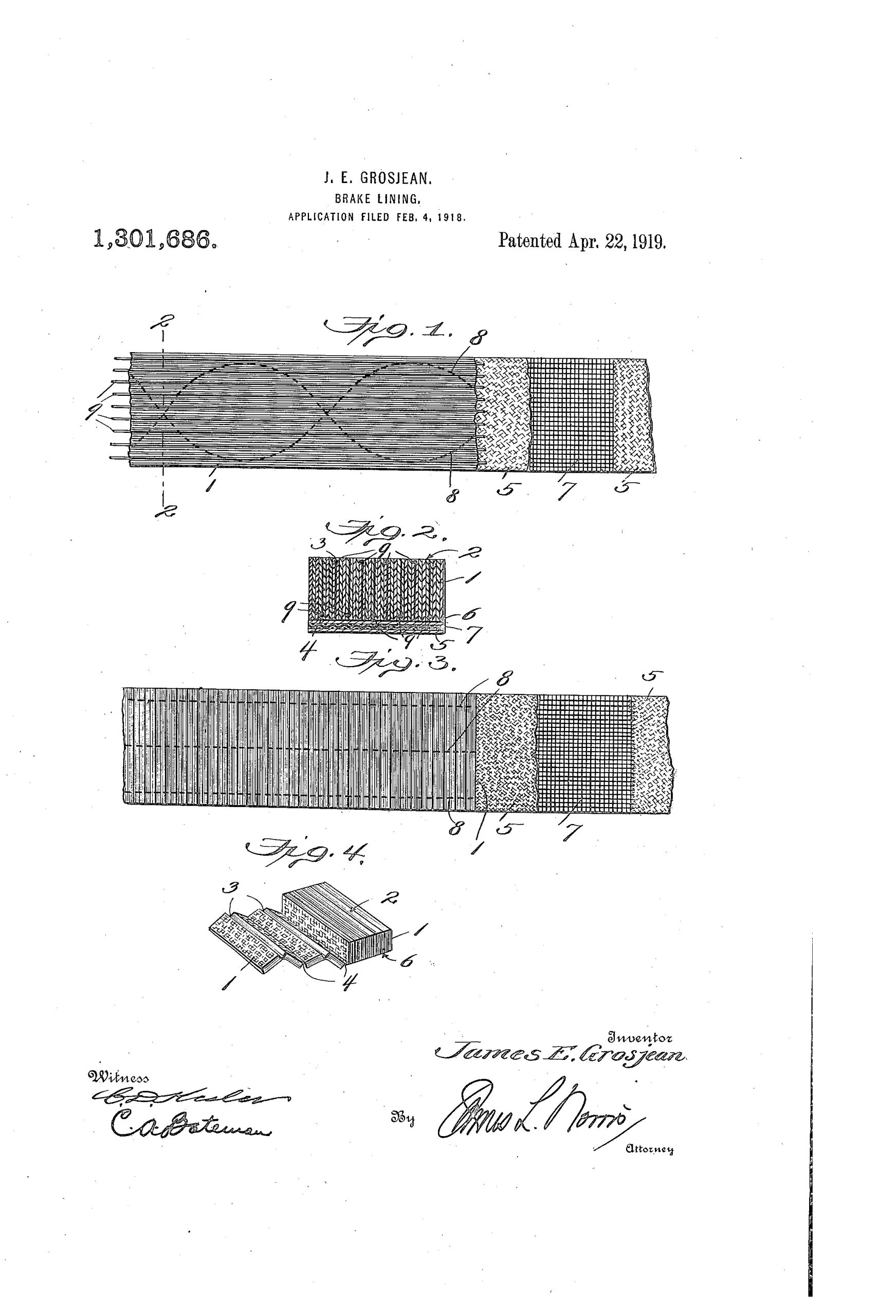
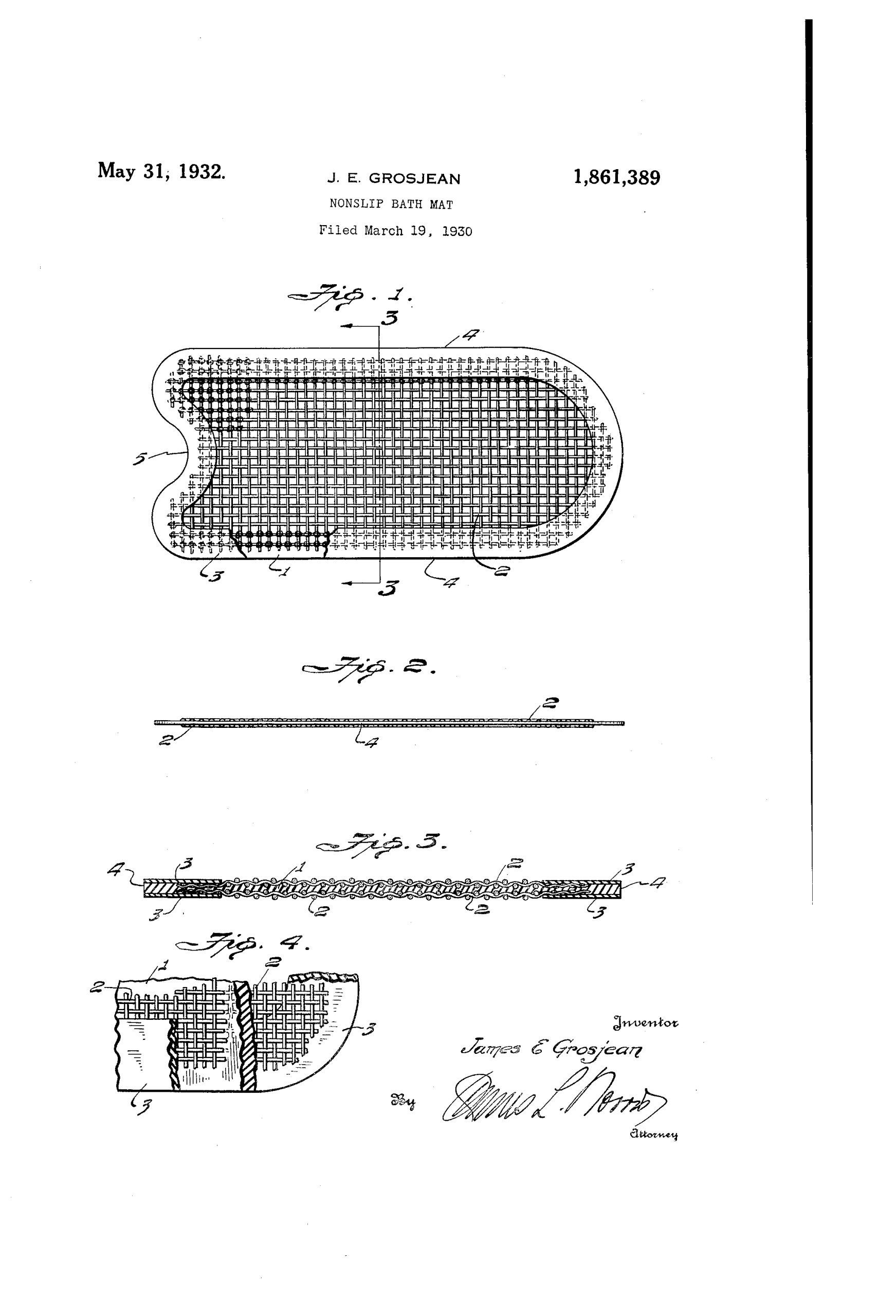
Grosjean’s other patents also dealt with rubber manufacturing. The first, patented in 1919, was a break-lining patent for breaks in machinery, specifically automobiles.[40] His idea was to layer different fibers, but unfortunately one of them was asbestos.[41] It was once again a product that focused on being inexpensive to manufacture while also being extremely durable.[42] Grosjean’s other patent was for a nonslip bathmat, patented in 1932.[43] It was another blend of rubber and other materials, with a rubber exterior and netting woven into the middle.[44] It also had a netted boarder for gripping ability and for design.[45] Specifically, it was to go inside a bathtub to help people not slip in the shower.[46] Alas, it was not clear whether Grosjean ever manufactured these products or sold them to another company to create and distribute. Overall, Grosjean had twenty patents, which further exemplifies his creativity and innovation. Likewise, in the case of the soles and horseshoes, Grosjean would work hard to create the perfect product.
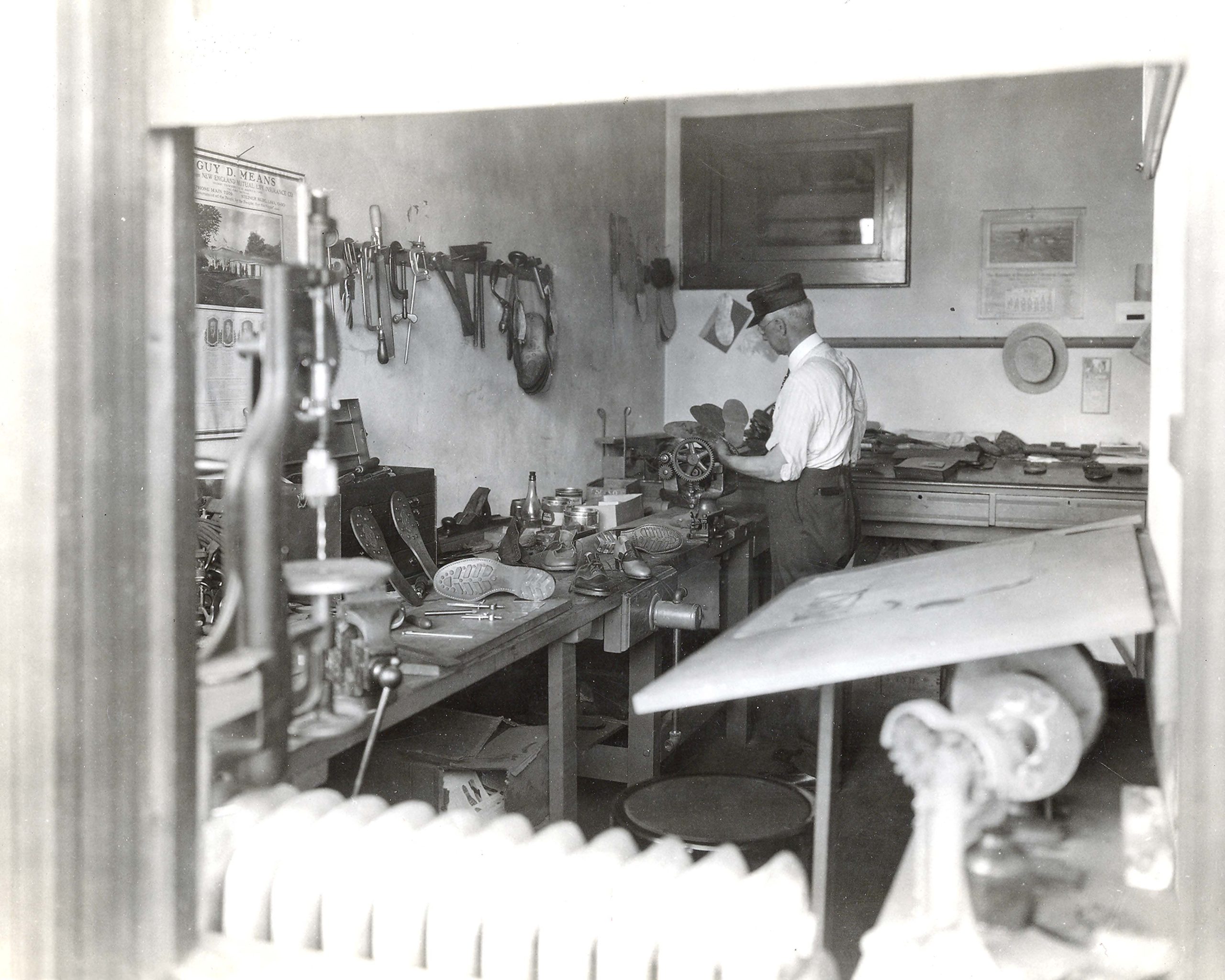
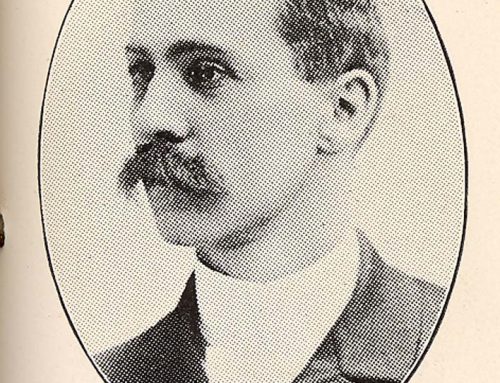
Grosjean lived a long and industrious life, which would come to an end in 1938. In November 1938, he contracted a severe case of pneumonia, which would cause him to deteriorate.[47] A few weeks later, he would suffer a heart attack and pass away on November 30, 1938.[48] He was a man who left behind quite a legacy, especially to the Allen County Museum. Grosjean was not only a founding member in 1908, but he was also the President of the Historical Society for a few years.[49] Likewise, after retiring, in February 1938, Grosjean became the Curator of Natural History at the museum, until he passed away.[50] As mentioned in last month’s article four of his five primary “spectacular machines” are on display at the Allen County Museum and loved by visitors and staff alike. Through them, we most often celebrate Grosjean’s genius in planning, mechanical engineering, and storytelling.
Endnotes:
[1] Kevin J. Elliott “Weekend Wanderlust: Allen County History Museum,” Columbus Monthly, December 18, 2019, accessed September 8, 2025, https://www.columbusmonthly.com/story/entertainment/human-interest/2019/12/18/weekend-wanderlust-allen-county-history/2035179007/
[2] “Humane Horseshoe,” The Times Democrat, December 5, 1905, in J. E. Grosjean file at the Allen County Archives.
[3] Ibid.
[4] The 1976 History of Allen County, Ohio, ed. John R. Carnes, Unigraphic Inc., Evansville, IN, 1976, 212.
[5] “Contract Awarded,” The Times Democrat, November 2, 1905, in J. E. Grosjean file at the Allen County Archives.
[6] A process by which molten hot metal is pressed multiple times into molds by a weighty hammer. “What is Drop Forging?” accessed October 1, 2025, https://www.whtildesley.com/processes/what-is-drop-forging and “Humane Horseshoe,” The Times Democrat, December 5, 1905, in J. E. Grosjean file at the Allen County Archives..
[7] https://patents.google.com/patent/US859758A/, https://patents.google.com/patent/US857554A/, https://patents.google.com/patent/US859810A/, and https://patents.google.com/patent/US876629A/
[8] “Saddle Horse,” Lima Times Democrat, October 23, 1906, in J. E. Grosjean file at the Allen County Archives.
[9] “Plant Sold,” Allen County Republican Gazette, March 8, 1910, in J. E. Grosjean file at the Allen County Archives.
[10] Lorraine Mayerson, “James E. Grosjean,” in J. E. Grosjean file at the Allen County Archives, 87.
[11] “The Early Automobile,” Iowa PBS, accessed October 1, 2025, https://www.iowapbs.org/iowapathways/mypath/2603/early-automobile.
[12] “Plant Sold,” Allen County Republican Gazette, March 8, 1910, in J. E. Grosjean file at the Allen County Archives.
[13] Ibid.
[14] Kim Kincaid, “A Sole Man,” The Lima News, June 2, 1999, in J. E. Grosjean file at the Allen County Archives.
[15] Ibid.
[16] “Lima Invention that Promises to Revolutionize the Shoe Sole Problem,” Lima Daily News, October 16, 1918, in J. E. Grosjean file at the Allen County Archives.
[17] Ibid.
[18] Ibid.
[19] Ibid.
[20] Ibid
[21] “[Boots and Shoes Patent],” accessed September 8, 2025, https://patents.google.com/patent/US1587377A/en, “[Method of Manufacturing Composite Sole for Boots or Shoes Patent],” accessed September 8, 2025, https://patents.google.com/patent/US1344503A, “[Patent for Sole for Boots and Shoes and Method of Making the Same],” accessed September 9, 2025, https://patents.google.com/patent/US1523956A/, “[Tread Material and Method of Making the Same Patent],” accessed September 9, 2025, https://patents.google.com/patent/US1687441A/, “[Sole for Boots and Shoes Patent],” accessed September 9, 2025, https://patents.google.com/patent/US1399766A/, “[Sole for Boots and Shoes Patent],” accessed September 9, 2025, https://patents.google.com/patent/US1297834A/, “[Sole for Boots and Shoes Patent],” accessed September 9, 2025, https://patents.google.com/patent/US1344504A/, “[Cushioned Sole Patent],” accessed September 9, 2025, https://patents.google.com/patent/US1611142A/, “[Sole for Boots and Shoes Patent],” accessed September 9, 2025, https://patents.google.com/patent/US1564060A/, and “[Method of Making Vulcanized Products Patent],” accessed September 9, 2025, https://patents.google.com/patent/US1470442A.
[22] Ibid.
[23] “[Heel for Boots and Shoes Patent],” accessed September 9, 2025, https://patents.google.com/patent/US1650511A/, “[Method of Making Vulcanized Products Patent],” accessed September 9, 2025, https://patents.google.com/patent/US1470442A/, “[Heel for Boot and Shoes Patent],” accessed September 9, 2025, https://patents.google.com/patent/US1563276A/, and “[Heel for Boots or Shoes Patent],” accessed September 9, 2025, https://patents.google.com/patent/US1439547A.
[24] “Grosjean vs. Panther-Panco Rubber Co.” accessed September 8, 2025, https://www.casemine.com/judgement/us/5914cc1badd7b04934807d24.
[25] Ibid.
[26]“[Shoe Sale],” in unknown Lima newspaper, circa January 1920, in J. E. Grosjean file at the Allen County Archives.
[27] “Rapid Progress on New Plant,” Lima Republican Gazette, April 1920, in J. E. Grosjean file at the Allen County Archives.
[28] “New Factory will be Ready soon says Grosjean,” LDR, May 26, 1920, in J. E. Grosjean file at the Allen County Archives.
[29] “Rapid Progress on New Plant,” Lima Republican Gazette, April 1920, in J. E. Grosjean file at the Allen County Archives.
[30] Ibid.
[31] Kim Kincaid, “A Sole Man,” The Lima News, June 2, 1999, in J. E. Grosjean file at the Allen County Archives.
[32] The 1976 History of Allen County, Ohio, ed. John R. Carnes, Unigraphic Inc., Evansville, IN, 1976, 212.
[33] Kim Kincaid, “A Sole Man,” The Lima News, June 2, 1999, in J. E. Grosjean file at the Allen County Archives.
[34] Ibid.
[35] “Plans for New Plant in Lima Announced by Gro-Cord Company,” Unknown newspaper, January 12, 1937, in J. E. Grosjean file at the Allen County Archives.
[36] Ibid.
[37] Kim Kincaid, “A Sole Man,” The Lima News, June 2, 1999, in J. E. Grosjean file at the Allen County Archives.
[38] Ibid.
[39] Ibid.
[40] “[Break-lining Patent],” accessed September 9, 2025, https://patents.google.com/patent/US1301686A/.
[41] Ibid.
[42] Ibid.
[43] “[Nonslip Bath Mat Patent],” accessed September 9, 2025, https://patents.google.com/patent/US1861389A/.
[44] Ibid.
[45] Ibid.
[46] Ibid.
[47] “J. E. Grosjean is Dead at 77 of Pneumonia,” unknown newspaper, December 1, 1938, in J. E. Grosjean file at the Allen County Archives.
[48] “Lima Inventor Dies,” The Newark Advocate, Newark, Ohio, November 30, 1938, accessed September 8, 2025, https://www.newspapers.com/newspage/287245090/.
[49] “J. E. Grosjean New President,” The Lima Daily News, March 19, 1915, in J. E. Grosjean file at the Allen County Archives.
[50] Lorraine Mayerson, “James E. Grosjean,” in J. E. Grosjean file at the Allen County Archives, 87.
Image Credit:
“[Horseshoe. Patent],” accessed October 21, 2025, https://patents.google.com/patent/US859810A/.
“[Tread material and method of making the same Patent,” accessed October 21, 2025, https://patents.google.com/patent/US1687441A/.
“[Sole for boots and shoes and method of making same Patent],” accessed October 21, 2025, https://patents.google.com/patent/US1523956A/.
“[Nonslip bath mat Patent],” accessed October 21, 2025, https://patents.google.com/patent/US1523956A/.
“[Break-lining Patent],” accessed October 21, 2025, https://patents.google.com/patent/US1301686A/.
All other images from the Allen County Archives.












Leave A Comment