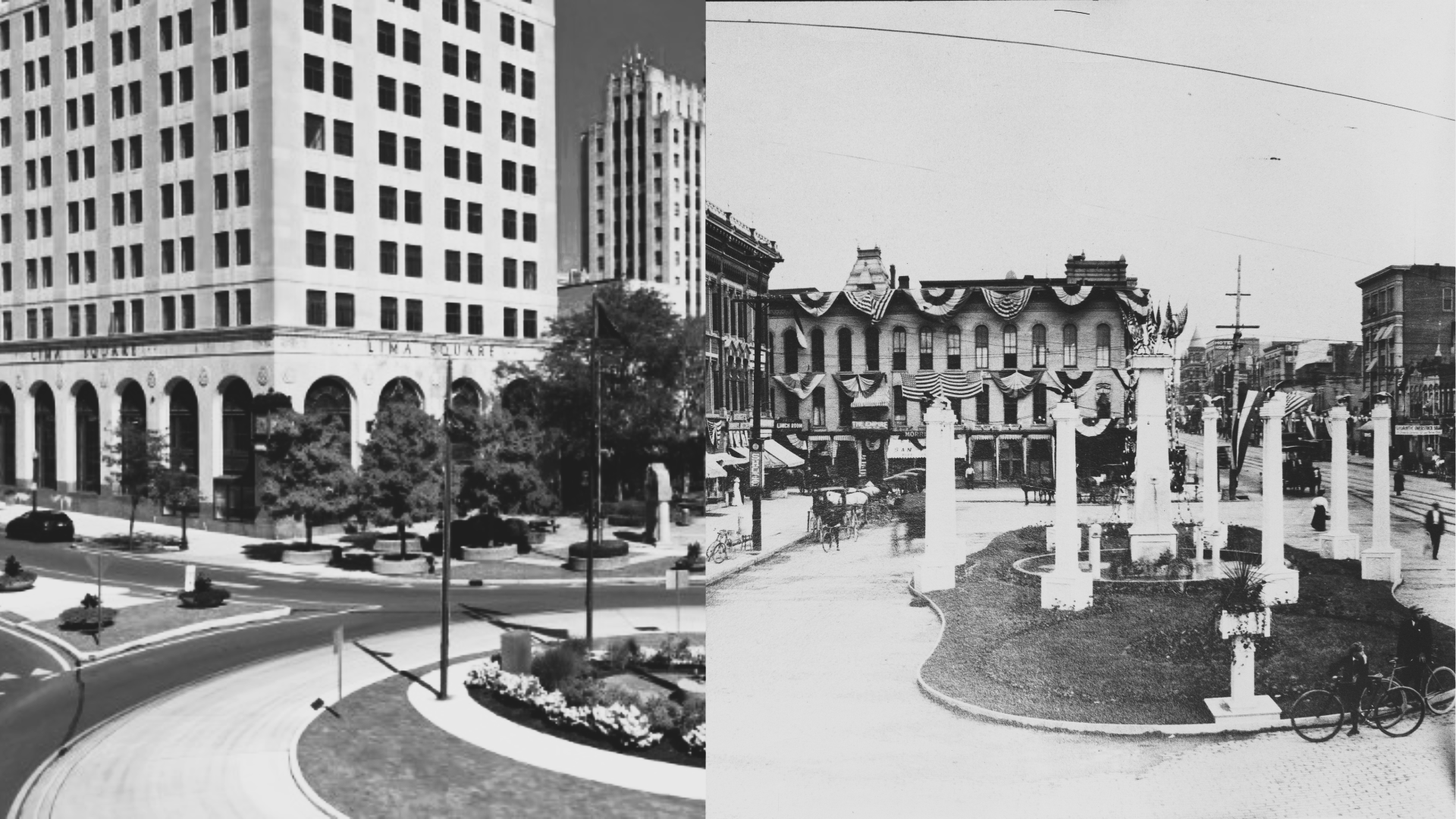
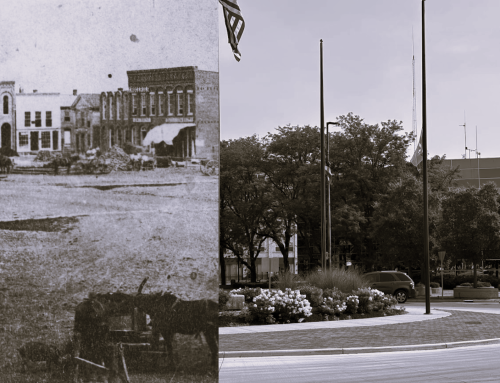
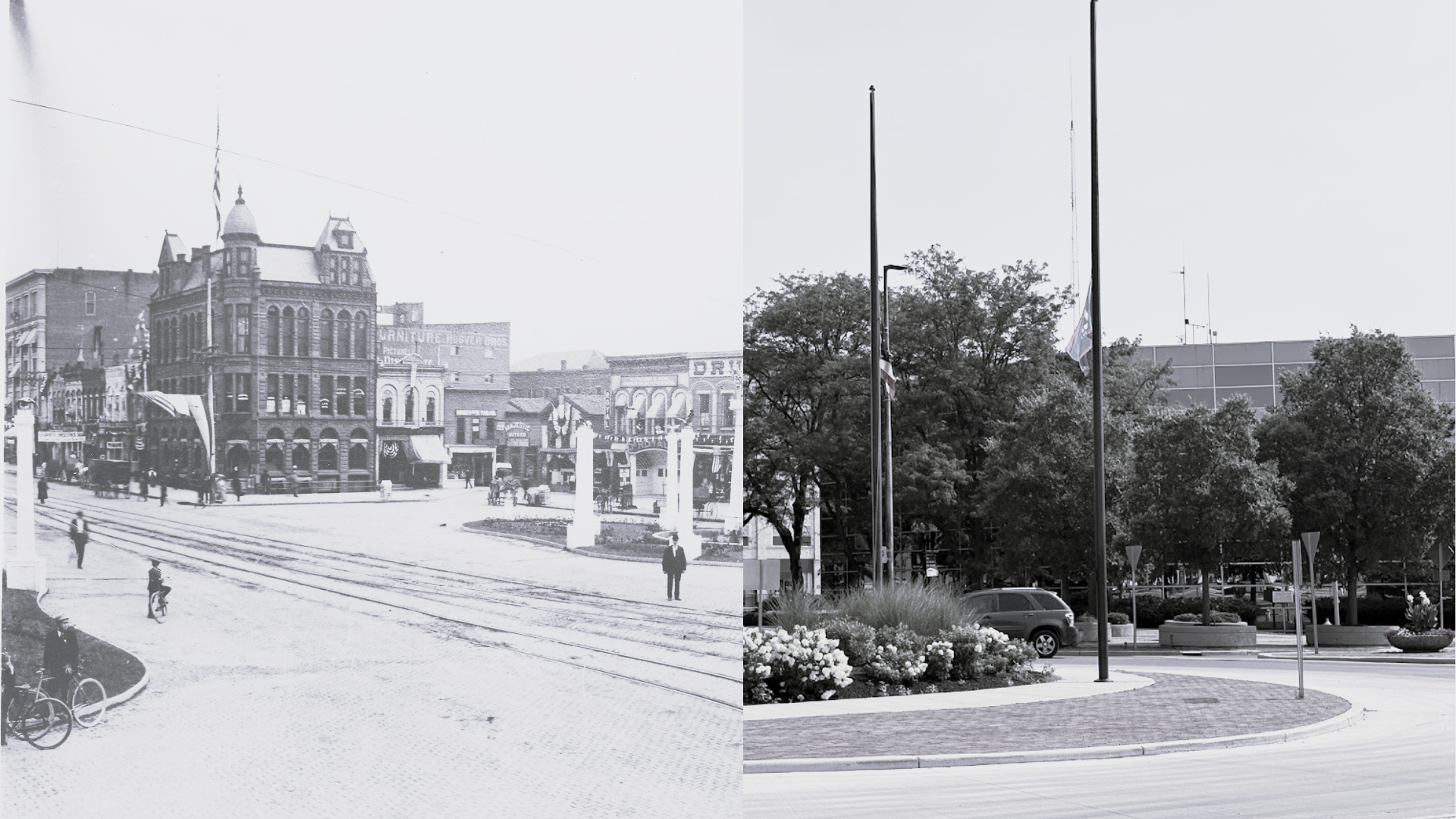
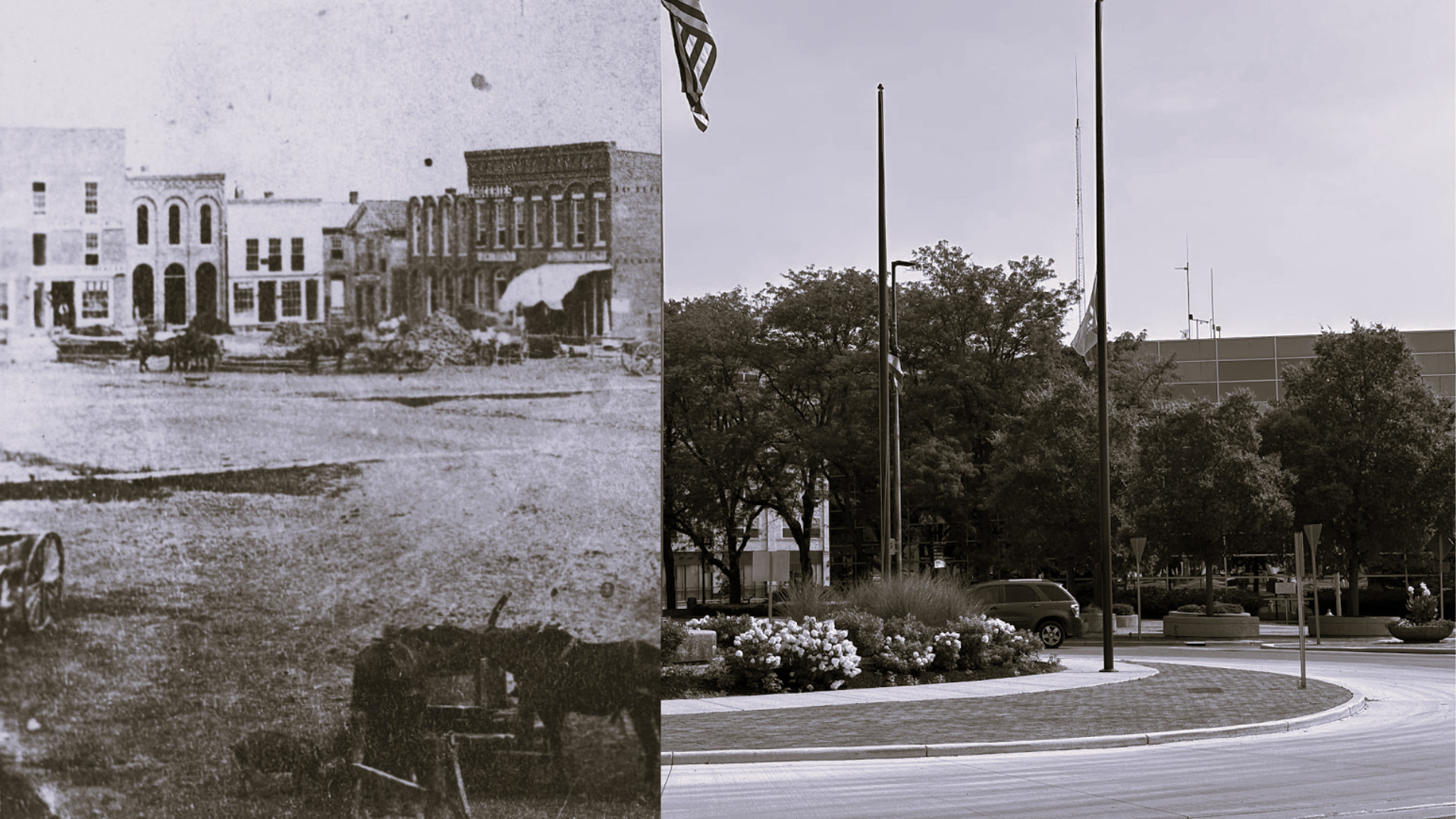
Today we will finish the story of the northwest corner of Public Square. Following the history of the business blocks from the Ashton Block, the most southern block, to Collins Block in the northwestern corner. Starting in 1900 and ending with today, we will cover the residents of these blocks.. This is an era of much modernization in the northwest corner, from theaters to high rises, the topography of the corner changed significantly.
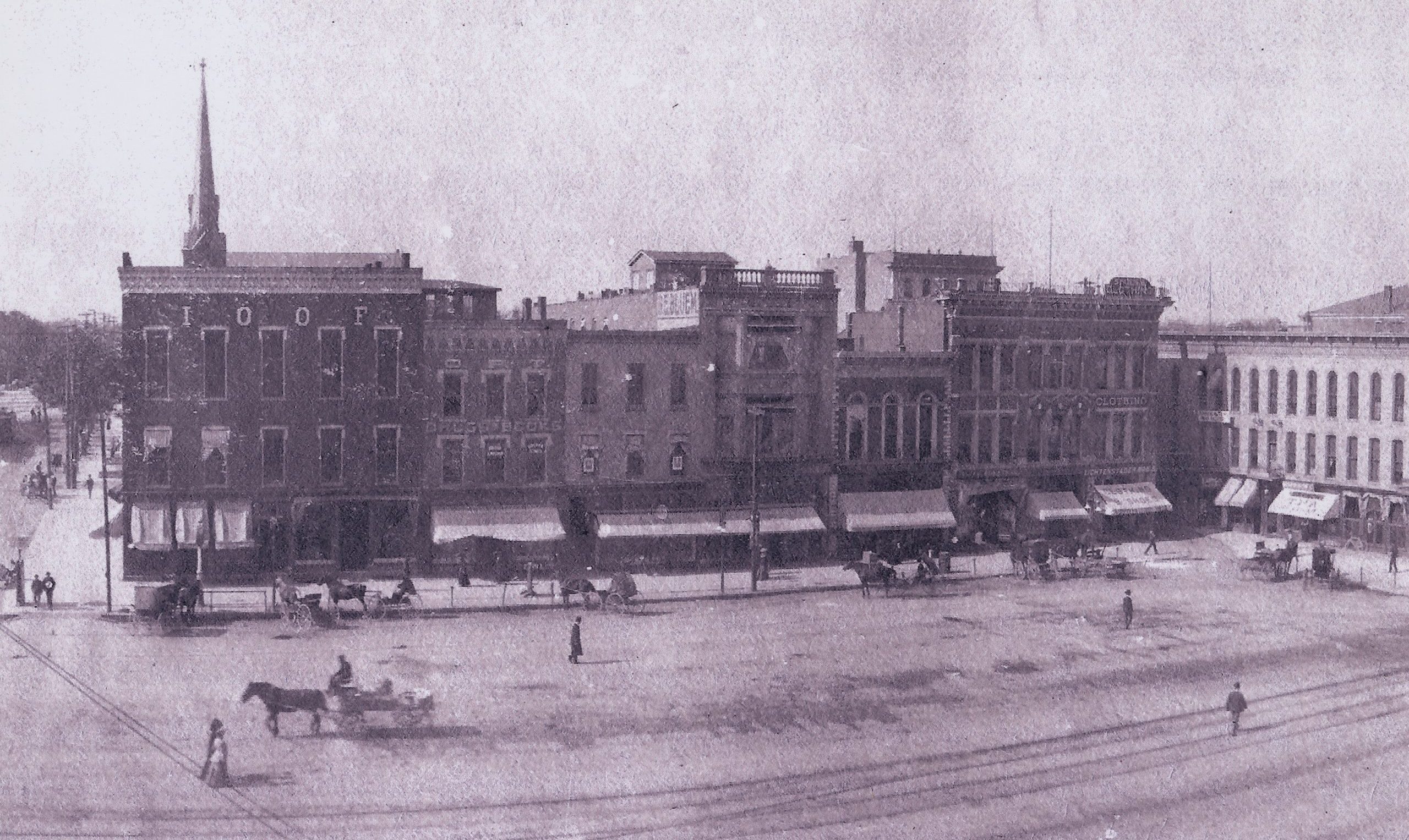
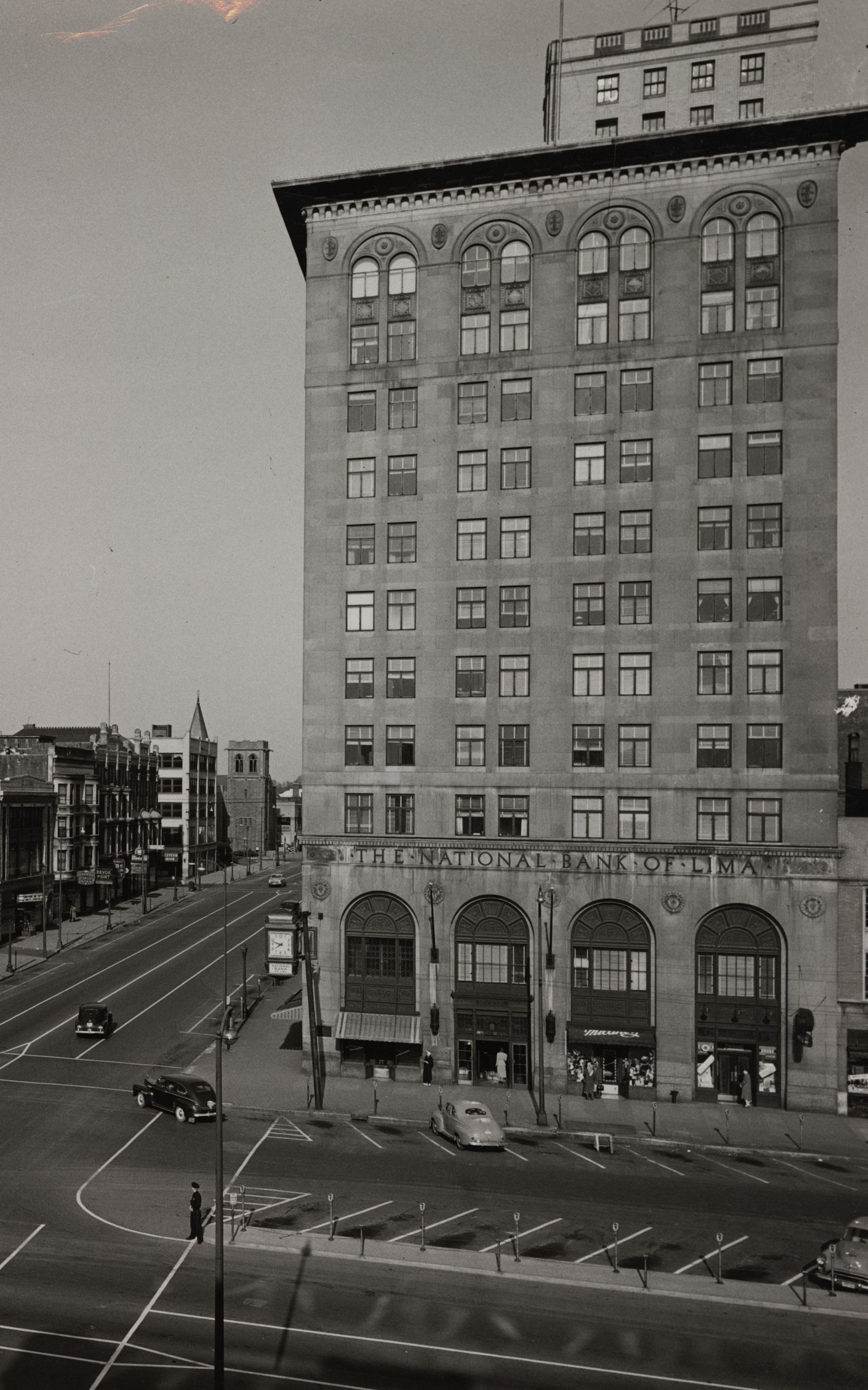
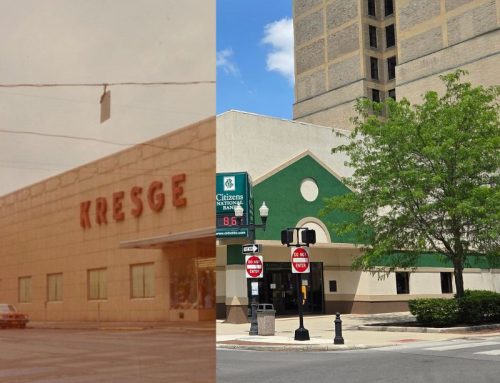
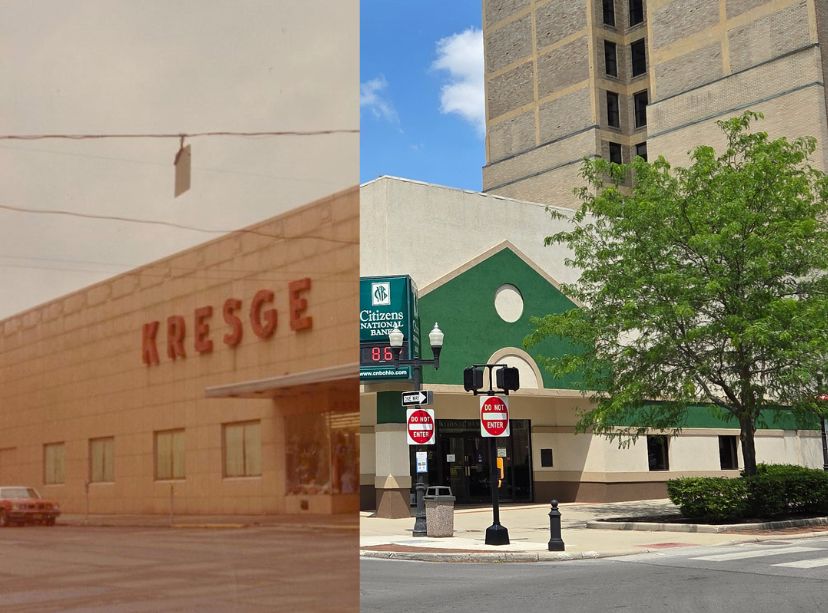
We will begin once again at the Ashton Block, where the First National Bank and Trust Building is today. Lima Trust Company moved into the Ashton Block in 1906, relocating from the Masonic Block.[1] Likewise, in 1909, one of the other longest standing businesses in this block, Hunter Drugstore, moved in.[2] They sold medicine, of course, but also coffee and regular drugstore items that are still sold in such stores today.[3] In 1922, Hunter Drugstore started developing film and printing photos for the citizens of the area.[4] This would be something that Hunter Drugstore was known for throughout the next several decades.[5] Both the drugstore and Trust Company would occupy this business block until 1925, when the Trust Company decided to build a larger building, the one that stands there today.[6] This is when the Sanford Hall building and Ashton Block become the same address, because the new building was much larger than the previous two structures. Temporarily, Hunter Drugstore relocated to 9 Public Square in the southwest corner, which we discussed in March’s article.[7] The grand new twelve story building changed the skyline of Lima.[8] In addition, it was a decadent build with American walnut, chandeliers, and the best fixtures of the era.[9] The Trust Company took over the majority of the building, but Hunter Drugstore came back and expanded in March of 1927.[10] They now had a soda grill and the store equaled the grandeur of the building by incorporating American walnut wood and electric lighting.[11] Likewise, Hunter expanded his business by leasing a cigar stand that was in the corner by the elevator.[12] Ashton Block turned into the Trust Building, one of the most modern business blocks of the era.
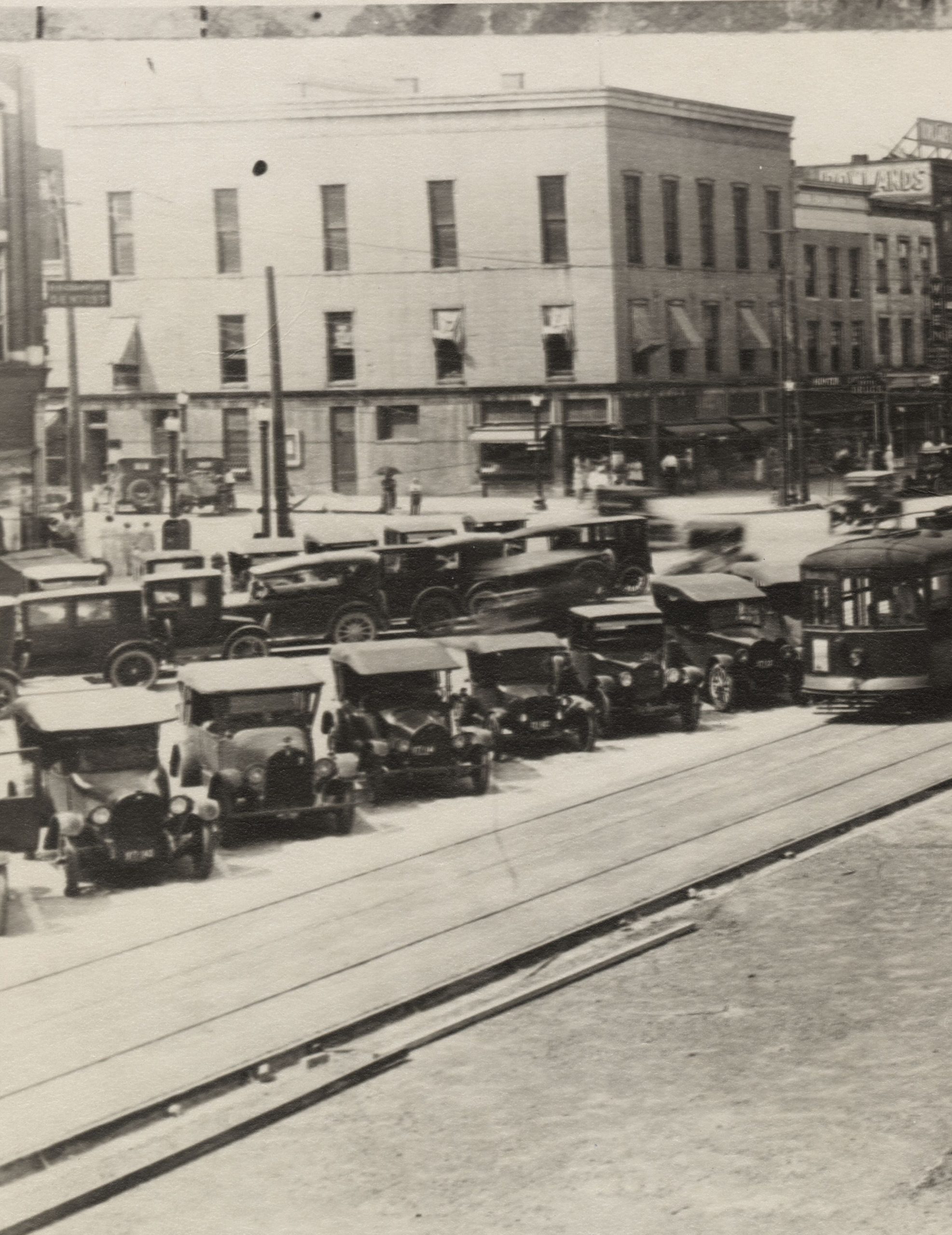
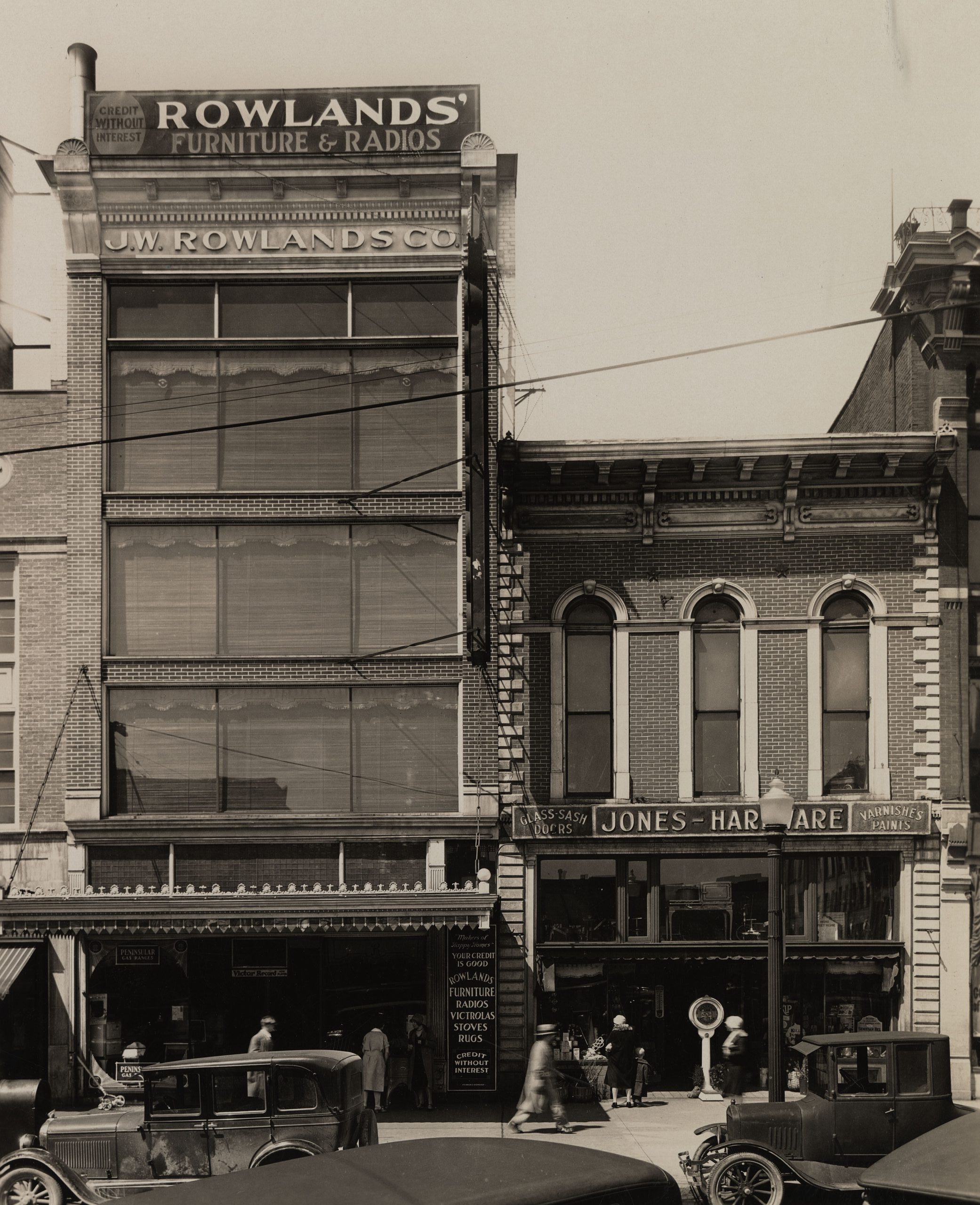
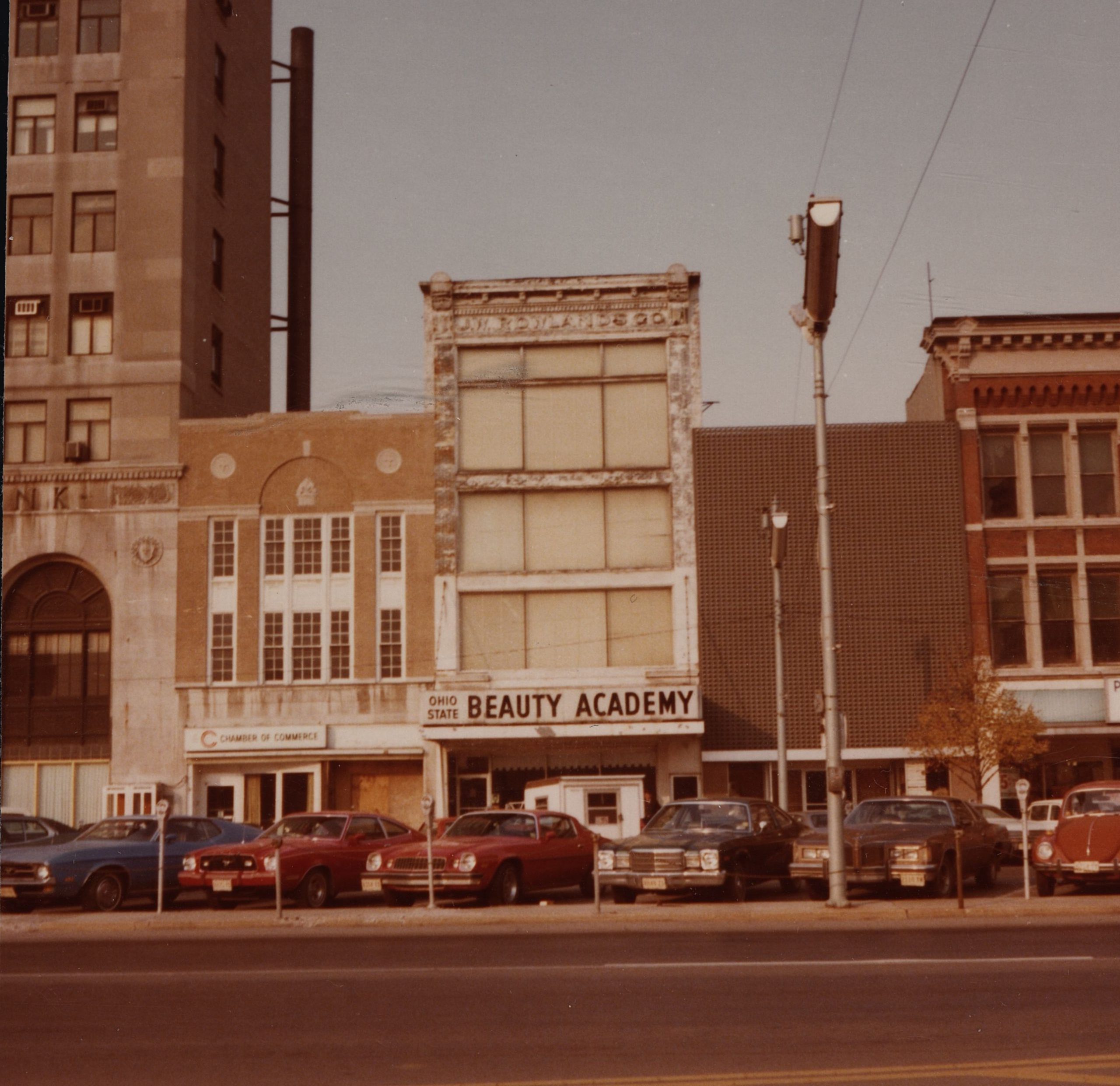
Moving a few buildings north to 57 Public Square, we find one of the most enduring furniture stores of the era, J.W. Rowlands Furniture.[13] The store had started several decades earlier on North Main Street.[14] Then in 1922, it moved into this larger three-story building.[15] The Rowlands were known for making a spectacle and the opening of this storefront was no different. The News reported, “More than 7,000 persons passed through the store with 6,000 carnations and roses being distributed as favors by the company.”[16] J. W. Rowlands Furniture was known for its furniture but also the families’ pageantry. Not only did they know how to sell furniture, but they also could draw a large crowd.. The new store sign was captivating as well, being 23 feet tall and 6 feet wide and depicting a rocking chair swaying back and forth with changing lights.[17] Only five years later in 1927, they added a fourth floor to the building.[18] However, the most memorable part of that renovation was the addition of an early escalator to the front of the building, which they then enclosed creating a new façade.[19] J.W. Rowland’s son Walter would eventually sell the store in 1946, and the name would change several times over the next few years.[20] Eventually it became Armstrong and Son Furniture, which would move to 115 W. Market Street in 1953.[21]
One building north at 59 Public Square, this corner’s connection to hardware stores continues with Jones Hardware. Last month, we covered both the Ashton and the Boone Hardware stores; Jones Hardware was the company’s latest iteration. Robert Perry Jones purchased the store in 1917.[22] Jones had learned the trade from his father and had been in business for years with a store on South Main Street.[23] He had also tried being a traveling hardware salesman for a few years, before purchasing this hardware store.[24] Between the previous hardware stores and Jones, Cover Hardware had been in business at 59 Public Square and was the oldest hardware store of the area.[25] After purchasing Cover Hardware, Jones remodeled the building and it became the Jones Hardware Company.[26] Its name soon became synonymous with high quality. The newspaper wrote about Jones Hardware Co., “Due to its progressiveness and foresight, it has been able to adapt itself to the changing times and it always provides good service and offers its customers high-class merchandise.”[27] In 1930, Harold Torbet would buy Jones Hardware and keep the name because of its recognition in the area.[28] The hardware store would stay there until 1969, when it moved to West Market Street.[29] Thus, the northwest corner of Public Square held some of the most beloved hardware stores of this county’s history.
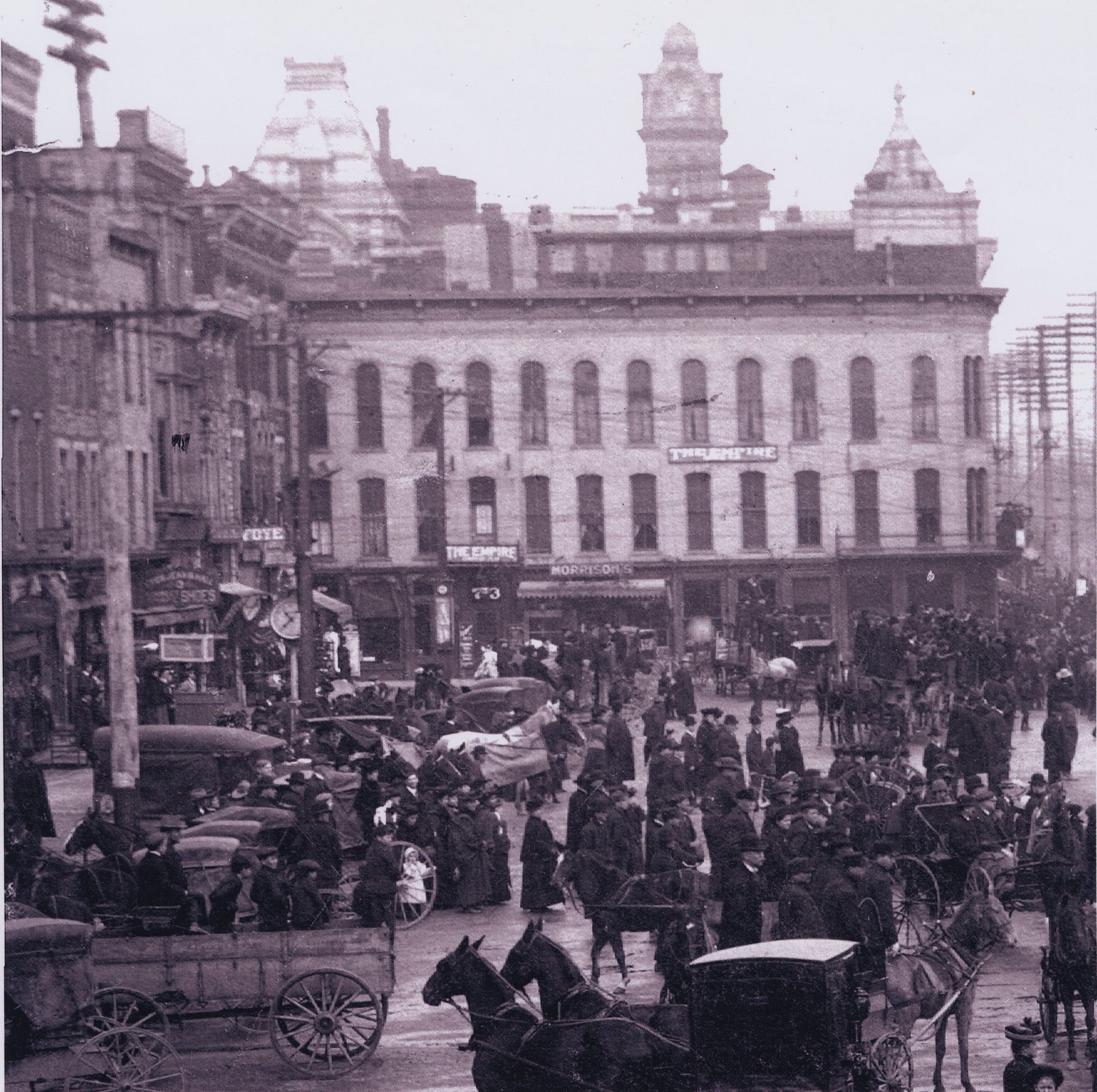
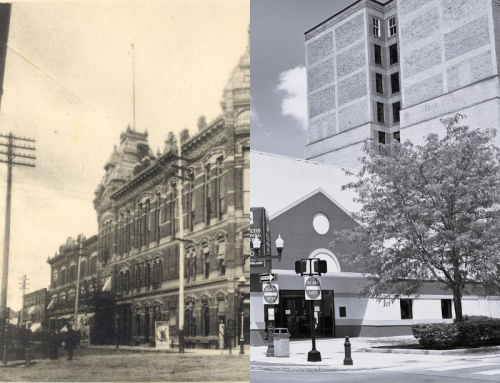
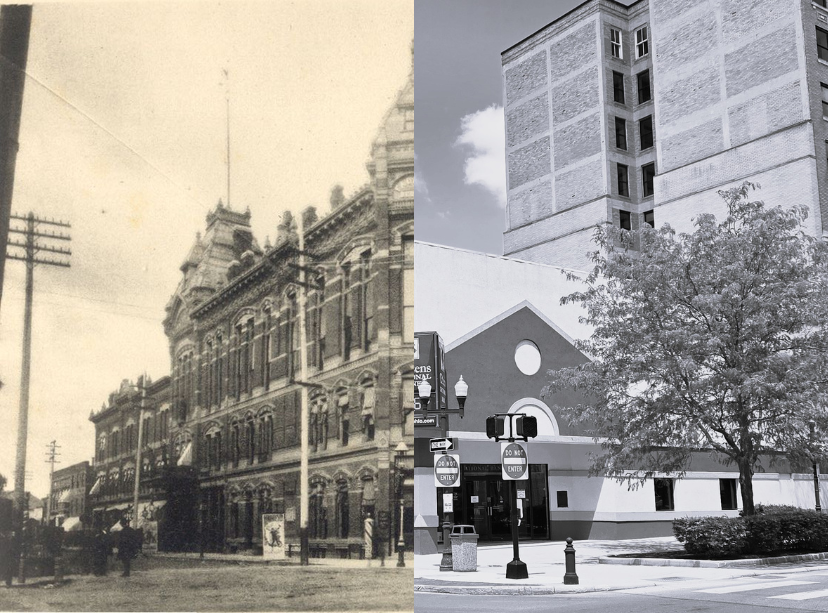
The Collins Block is the most northern business block in the northwest corner. In the first decade of the 20th century, Empire Hotel set up on the third floor of the block.[30] On March 18, 1911, the Empire Theater also opened there.[31] Although at that time the Empire Hotel was better known, the theater soon became a beloved institution.[32] It had inclined seating for 300 so everyone could see the screen and watch the films, which at first were mostly silent films and travel programs.[33] A few years later in 1915, the theater started showing “first-run goof pictures,” the premier comedies of the area, and the theater began to draw in large crowds.[34] Because of its popularity, it was closed in 1919 to expand the theater to 1,200 seats.[35] The theater became much more refined during the revamp. Draperies, perhaps for the stage, were made by The Leader Store out of silk velour.[36] The Leader Store then displayed them in their shop window until the theater was completed, advertising both their skill and the theater.[37] Likewise, an orchestra pit and orchestral organ were added to the theater.[38] During this era of movie theaters, an organist would often create the sounds of a silent film to make it even more entertaining for the viewers. When the renovation was finished in 1920 the name was changed to Sigma Theater.[39] Soon thereafter, the Rirzler family became the theater managers.[40] They also managed many other theaters in the area, including the Lyric, State, and Faurot Opera House, and their name was synonymous with good entertainment in Allen County.[41] In the early 1930s, the Rirzlers would connect their enterprise to the Warner Brothers Theaters.[43] That is where we will leave the Sigma’s story for now.
Circling back to the Ashton Block in the 1930s during The Great Depression, which became a difficult time for the entire building block. Mostly because its main tenant, the Lima Trust Company, struggled, like all the banks of the time. It would merge with the First American Bank & Trust creating the Lima First American Trust Company in 1931.[44] Not long after this merger the company went into receivership, meaning it did not have enough money to continue business.[45] This was in the era before the Federal Deposit Insurance Corporation, FDIC, thus most of the people who used the bank would have lost all the money they had deposited there. Later, the National Bank of Lima would take over the Trust Company’s offices and run out of the block for several decades.[46] Throughout The Great Depression, Hunters Drugstore continued to operate, passing on to the original owner’s children. While Frank and Robert Hunter operated the store in the Ashton Block,[47] some of their other siblings ran stores around Lima.[48] It was considered one of the areas institutions and lasted under the Hunter name until 1964, when Robert “Bob” Hunter passed away.[49] After that, one of the employees purchased the store; it became known as the Hawkey Reaman Prescription Center, which eventually moved to Elmview Drive.[50] Thus, Hunters Drugstore called the Ashton Block its home for 55 years.
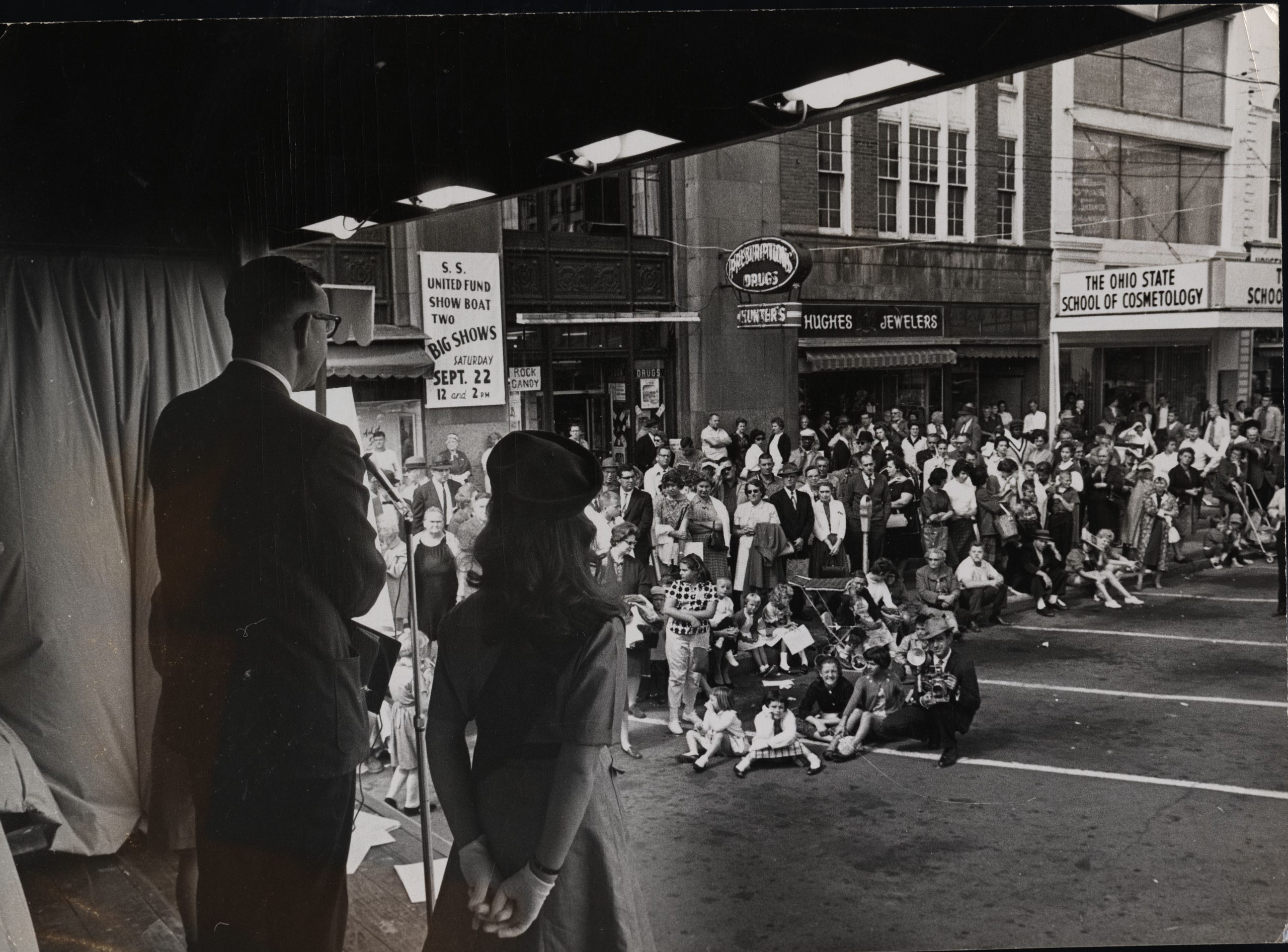
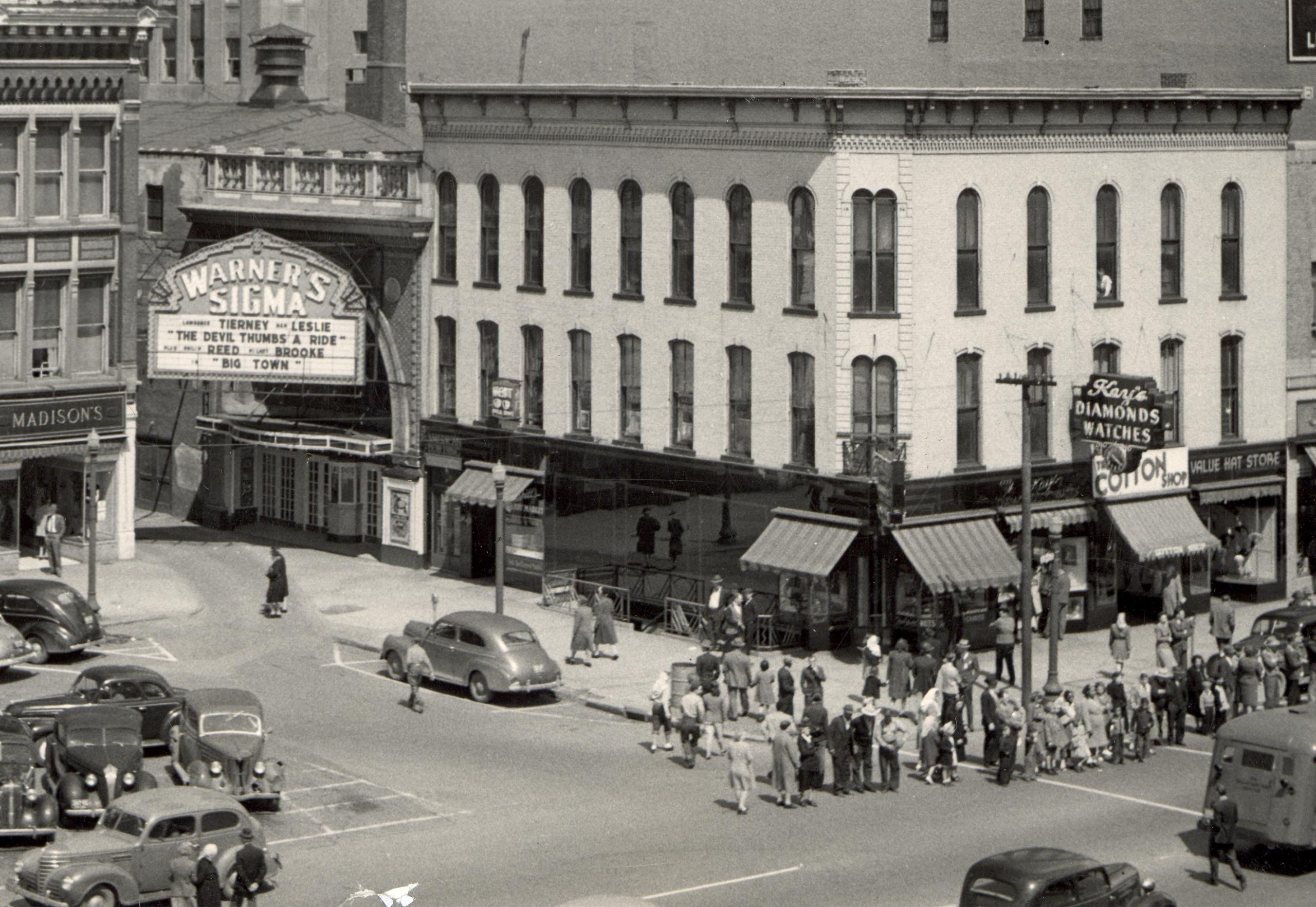
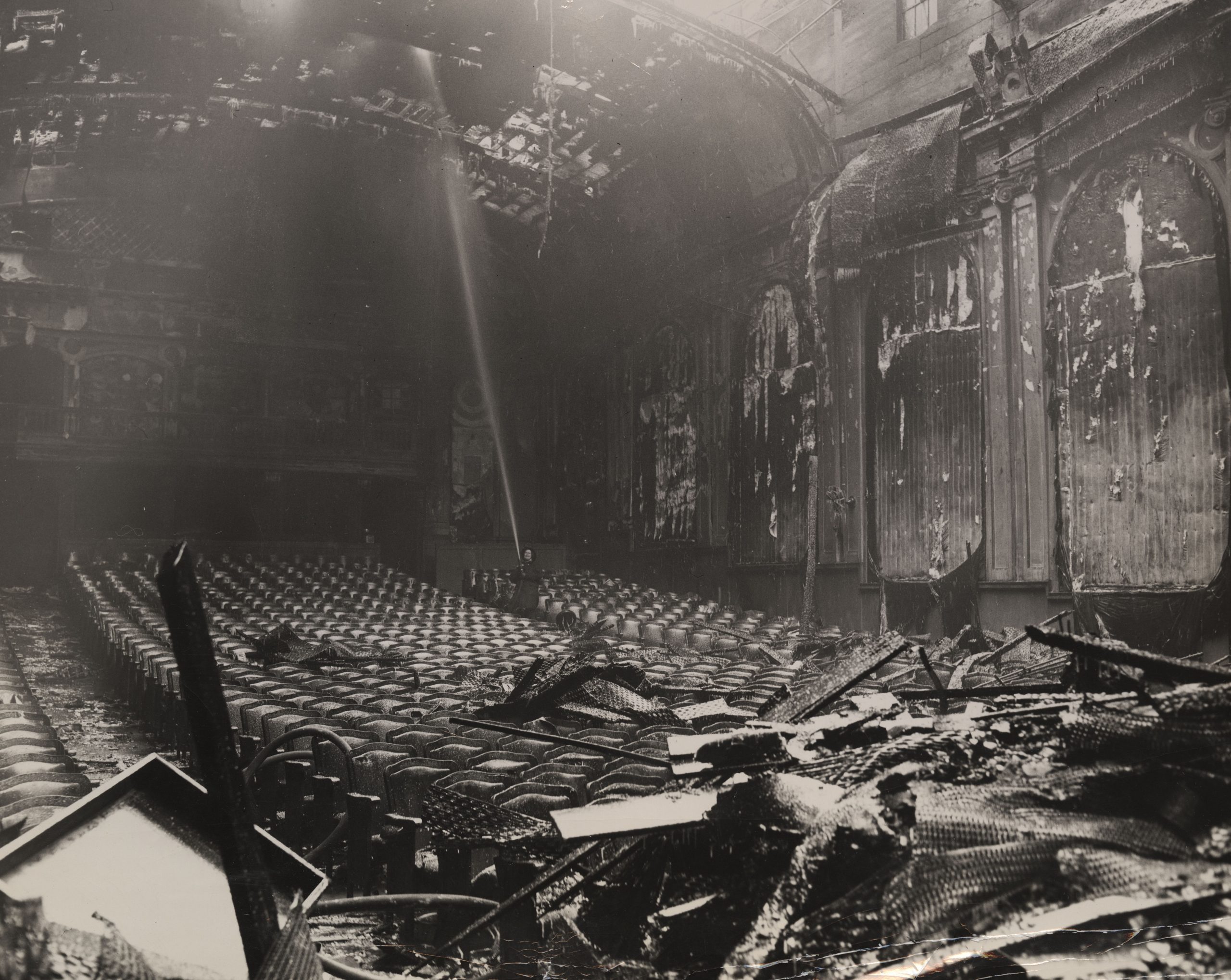
Moving north to the Collins Block once again, the Sigma Theater had been growing steadily since Warner Brothers operated with the Rirzlers. However on March 1, 1949, the Sigma Theater was badly damaged in a fire, and from the reports, it seemed that the fire started in the women’s restroom in the middle of the night.[50] A police officer making his rounds discovered it.[51] Still, the fire had consumed most of the building by the time the firemen got to the scene.[52] It was estimated that the fire caused $200,000 in damages, or over $2.7 million today.[53] Because of this large price tag the owners held off rebuilding for a few months.[54] Finally, money was put towards the remodel; it was re-opened March 1, 1950.[55] The remodel was so rushed that the marquee was finished only moments before the opening.[56] They showed Alfred Hitchcock’s “Stage Fright” as the first film back.[57] With the remodel, Sigma Theater became popular once again for around a decade.
As time flies by, we once again move back to the Ashton Block, this time in the 1970s. We left it with the National Bank of Lima calling it home and Hunters Drugstore moving out. In 1974, Huntington Bank would move into Ashton Block.[58] Although that bank would also vacate the building years later.[59] Today the First National Bank and Trust Building is on the National Register of Historic Places.[60] The building has been mostly vacant for the last few decades.[61] Today the 43 Town Square Apartments are in that building.
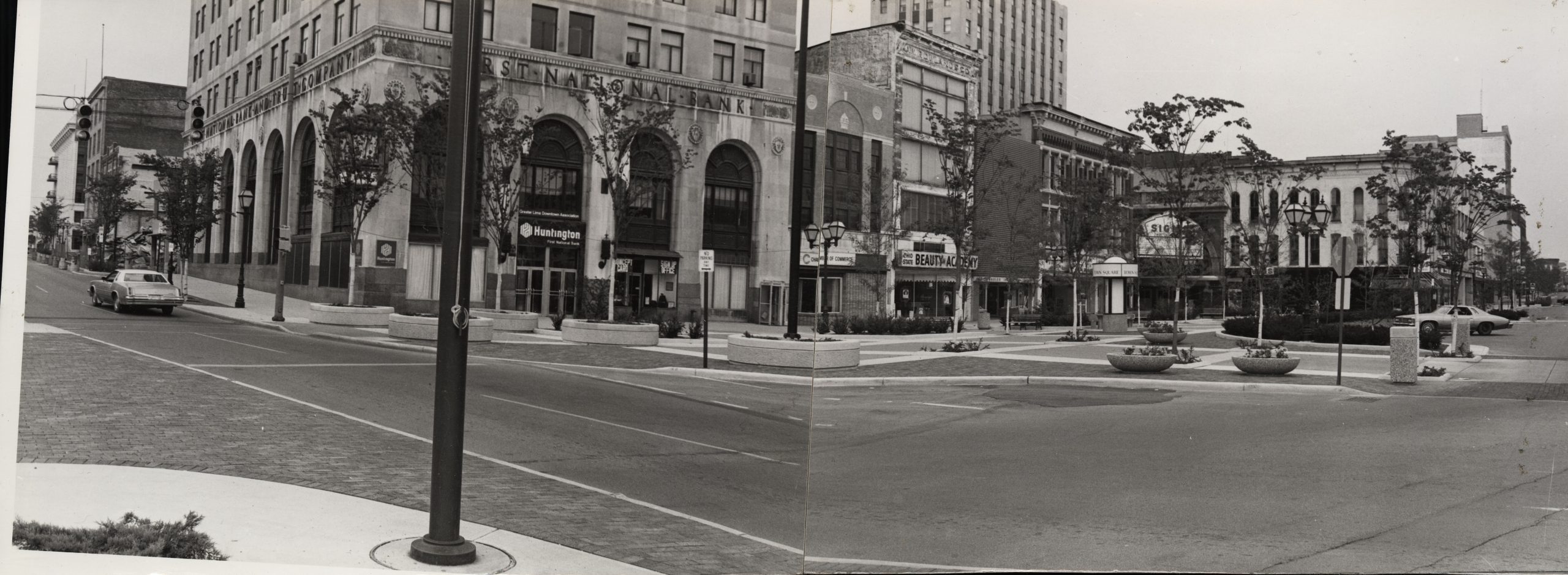
Moving onto the middle blocks. Over the decades, many businesses have come and gone from these few middle business buildings. These include: the Ohio Beauty School, the Chamber of Commerce, a pharmacy, and a clothing store. Today, the two main institutions operating in that area are Woof Boom Radio and ArtSpace Lima. Both are rooted in this area and focus on sharing arts and entertainment with the public.
The Collins block has had the most change between the late 1900s and today. The Sigma Theater started to struggle in the 1960s, and it once again became a second-run theater—typically running older films at a low admission fee.[62] It was purchased by William Dakota in 1972, who was from Flint, MI.[63] He renamed it Cinema 1 and modernized the theater with self-rising seats and new projectors.[64] Unfortunately, Dakota decided to turn the theater into an X-rated film theater, which was disliked by the public, especially officials of Allen County.[65] There was litigation which was hard to argue for or against in court, but the bad light and public distaste soon ran the theater out of business.[66] In 1981, the building was turned into an office building by the Ohio Bureau of Workers’ Compensation.[67] Then in 1996, St. Rita’s Medical Center bought it.[68] Today High Road School of Lima is in the block, having moved into the building in 2022.[69] High Road School of Lima is a “non-public school serving students with disabilities in kindergarten through 12th grade.”[70] The façade of the building is still the same as the Empire Teater because it is on the National Register of Historic Places.[71] Thus, the building has not changed much physically on the outside, but now serves as a school for the most deserving of students.
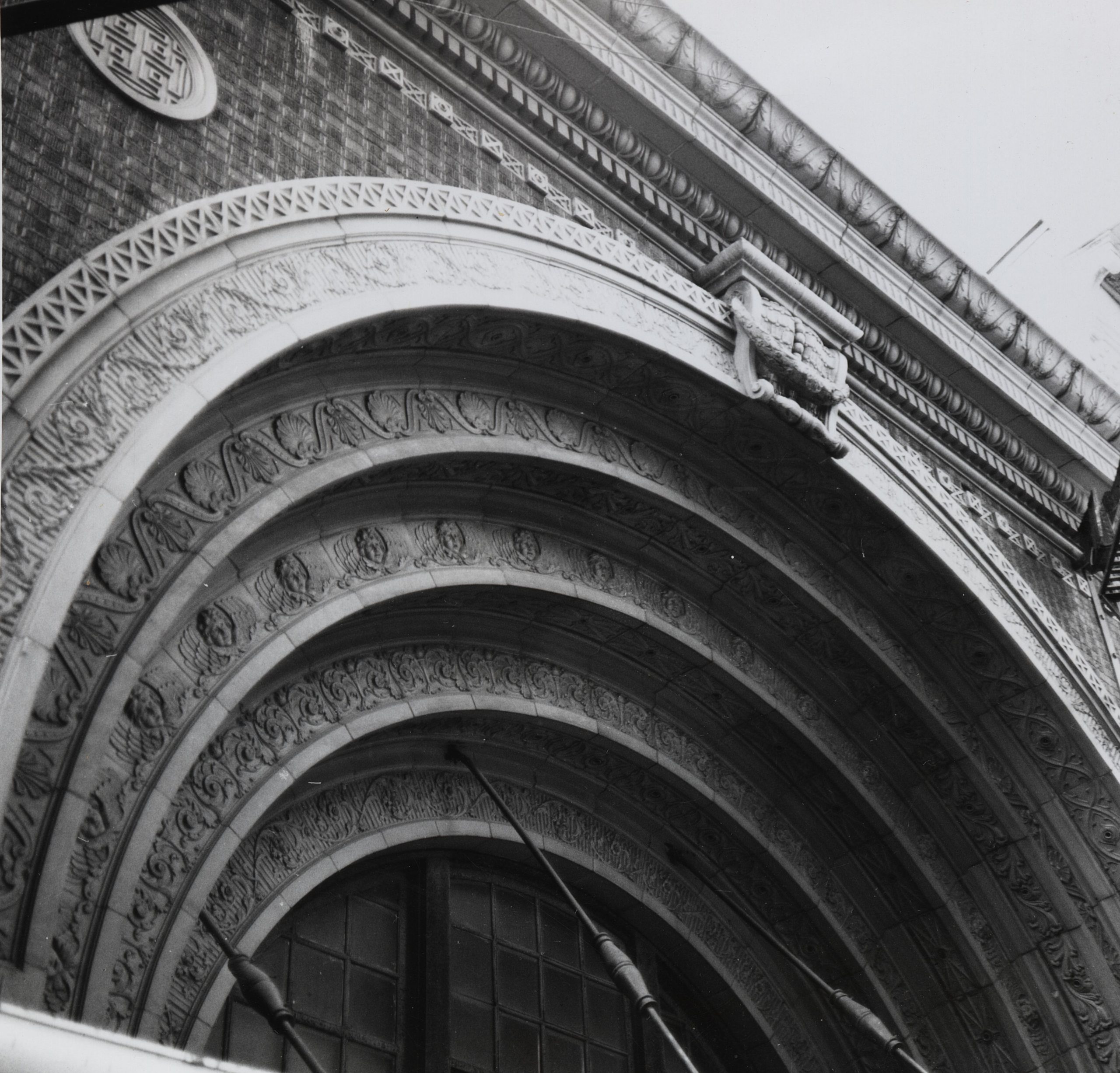
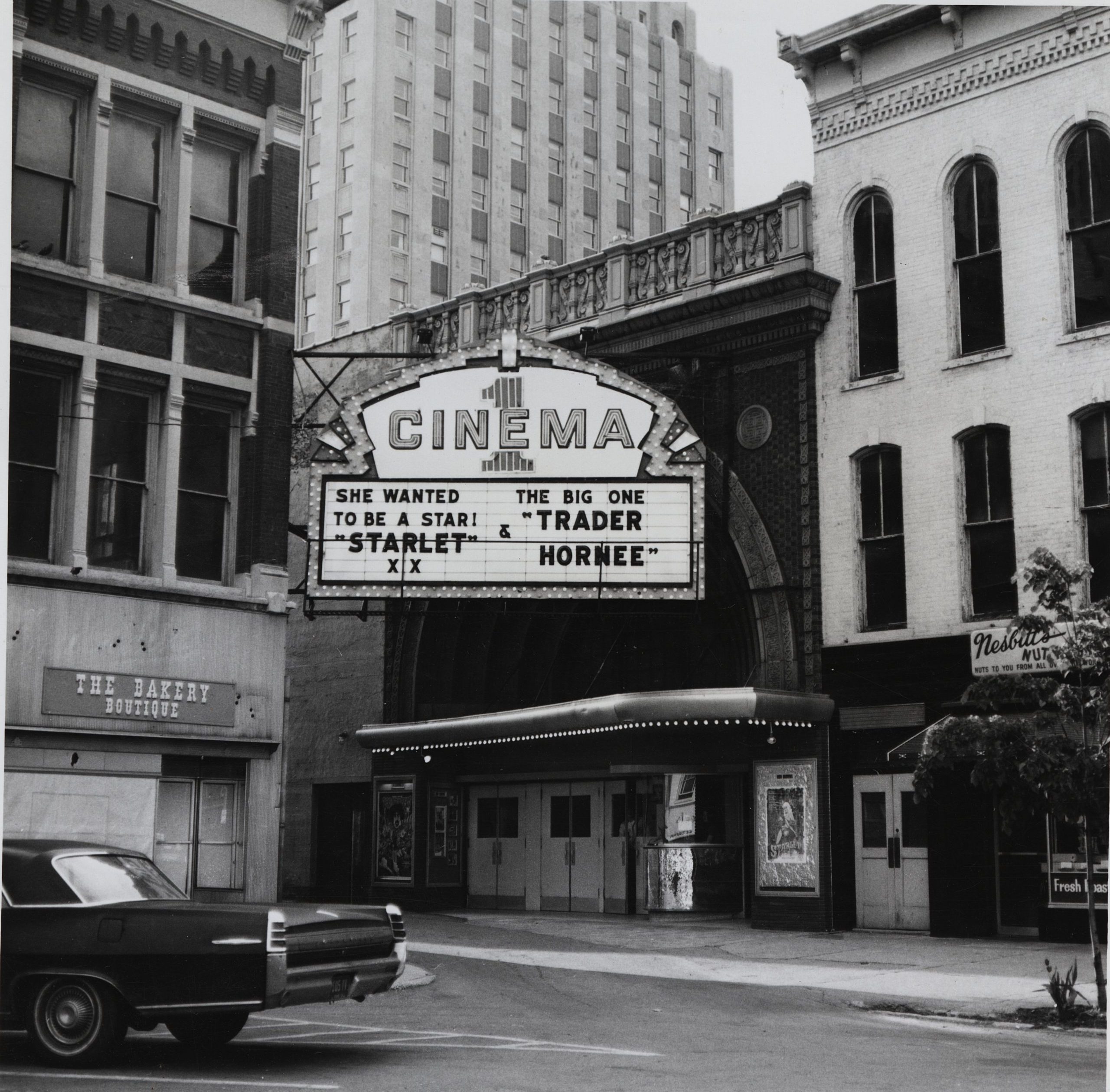
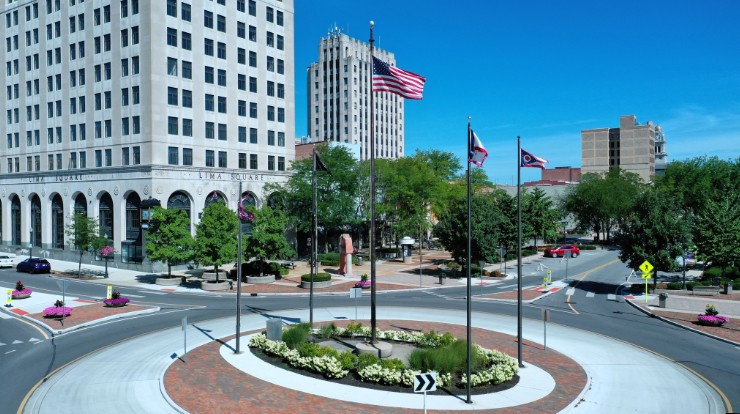
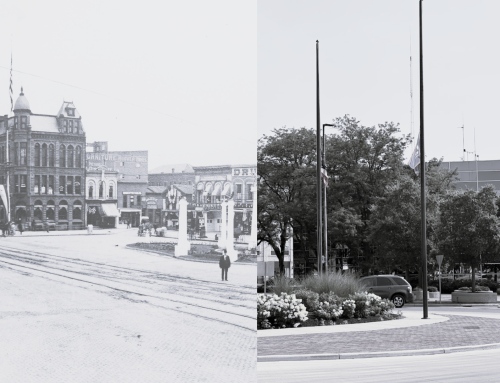
From the 1900s to today, the northwest corner of the Public Square has undergone significant transformation. There are now two buildings on the National Register of Historic Places: the façade of the Empire Theater and the First National Bank and Trust Building. Likewise, the area was always a center of entertainment from the halls of the 1800s to the theater of the early 1900s and today hosts Woof Boom Radio and ArtSpace Lima for art and culture. Just as in the 1800s, the northwest corner of the Public Square exemplifies the changes in Allen County over time.
Endnotes:
[1] Anna Selfridge, “A Walk on West Market,” The Allen County Reporter, Vol. LXIV, 2010, No. 1, 6.
[2] Adrienne McGee, “The Hunter Drugstores,” Lima News, July 21, 2010, in Hunters Drug Store file at the Allen County Archives.
[3] Ibid.
[4] Ibid.
[5] Ibid.
[6] Ibid.
[7] “Hunter’s Drug Store to Move to Old Stand,” Lima Sunday News, December 12, 1926, in Hunters Drug File at the Allen County Archives.
[8] Anna Selfridge, “A Walk on West Market,” The Allen County Reporter, Vol. LXIV, 2010, No. 1, 6.
[9] “Hunter’s Drug Store to Move to Old Stand,” Lima Sunday News, December 12, 1926, in Hunters Drug File at the Allen County Archives.
[10] Ibid.
[11] Ibid.
[12] Ibid.
[13] Greg Hoertsten, “Rowlands Furniture: Sons continued to expand store, lure in customers,” January 27, 2016, Lima News, in Reminisce Files at the Allen county Museum.
[14] Ibid.
[15] Ibid.
[16] Ibid.
[17] Ibid.
[18] Ibid.
[19] Ibid.
[20] Ibid.
[21] Ibid.
[22] Kim Kincaid, “Closing Marked the End of an Era: The Hardware Store,” June 19, 2002, Lima News, in Reminisce Files at the Allen County Archives.
[23] Ibid.
[24] Ibid.
[25] Ibid.
[26] Ibid.
[27] Ibid.
[28] Ibid.
[29] Ibid.
[30] Greg Hoersten, “Samuel Collins: Tied to Lima’s Early Days,” Lima News, August 1, 2018, in Reminisce Files at the Allen County Archives.
[31] “Cinema 1: 69 Public Square Lima, OH 45801,” accessed October 29, 2025, https://cinematreasures.org/theaters/18684.
[32] Adrienne McGee, “Let’s Go to the Movies,” Lima News, August 31, 2011, in Reminisce files at the Allen County Archives.
[33] Ibid.
[34] Ibid.
[35] Greg Hoersten, “Samuel Collins: Tied to Lima’s Early Days,” Lima News, August 1, 2018, in Reminisce Files at the Allen County Archives.
[36] Adrienne McGee, “Let’s Go to the Movies,” Lima News, August 31, 2011, in Reminisce files at the Allen County Archives.
[37] Ibid.
[38] Ibid.
[39] “Cinema 1: 69 Public Square Lima, OH 45801,” accessed October 29, 2025, https://cinematreasures.org/theaters/18684.
[40] Adrienne McGee, “Let’s Go to the Movies,” Lima News, August 31, 2011, in Reminisce files at the Allen County Archives.
[41] Ibid.
[42] Ibid.
[43] Anna Selfridge, “A Walk on West Market,” The Allen County Reporter, Vol. LXIV, 2010, No. 1, 6.
[44] Ibid.
[45] Ibid.
[46] Ibid.
[47] Adrienne McGee, “The Hunter Drugstores,” Lima News, July 21, 2010, in Hunters Drug Store file at the Allen County Archives.
[48] Ibid.
[49] Ibid.
[50] Adrienne McGee, “Let’s Go to the Movies,” Lima News, August 31, 2011, in Reminisce files at the Allen County Archives.
[51] Ibid.
[52] Ibid.
[53] Adrienne McGee, “Let’s Go to the Movies,” Lima News, August 31, 2011, in Reminisce files at the Allen County Archives and “CPI Inflation Calculator,” accessed March 5, 2026, https://www.in2013dollars.com/us/inflation/1949?amount=200000
[54] Adrienne McGee, “Let’s Go to the Movies,” Lima News, August 31, 2011, in Reminisce files at the Allen County Archives.
[55] Ibid.
[56] Ibid.
[57] Ibid.
[58] Anna Selfridge, “A Walk on West Market,” The Allen County Reporter, Vol. LXIV, 2010, No. 1, 6.
[59] Ibid.
[60] Ibid.
[61] Ibid.
[62] Adrienne McGee, “Let’s Go to the Movies,” Lima News, August 31, 2011, in Reminisce files at the Allen County Archives.
[63] “Cinema 1: 69 Public Square Lima, OH 45801,” accessed October 29, 2025, https://cinematreasures.org/theaters/18684.
[64] Ibid.
[65] Adrienne McGee, “Let’s Go to the Movies,” Lima News, August 31, 2011, in Reminisce files at the Allen County Archives.
[66] Ibid.
[67] Ibid.
[68] Ibid.
[69] Dean Brown, “High Road School Opens Downtown,” Lima News, October 17, 2022, accessed March 11, 2026, https://www.limaohio.com/top-stories/2022/10/17/high-road-school-opens-downtown/.
[70] Ibid.
[71] Ibid.
Image Credit:
Downtown Lima Inc., Instagram Post, accessed May 1, 2026, https://www.instagram.com/p/DCPYhMfid-u/.
All other images are from the collection of the Allen County Archives or taken by an Allen County Museum staff member.












Leave A Comment